One of the most important decisions we make for our dog, is which obedience training method to use.
This choice will affect the happiness and well-being of our dog, as well as shape our long-term relationship with our furry best friend.
Dog training is an area where emotions run hot, and we will hear many strong opinions or judgments from just about anyone and everyone.


The key to dog obedience training is not to be overly influenced by any one source. Gather information on a variety of methods, from a variety of sources, then judge which is the best one for you and your dog.
Some people may tell us that, “Obedience method X will never work for our dog, because he is too dominant, stubborn, fearful, or aggressive“.
Simplistic statements like these are never true. It is better to research the training method ourselves, and form our own opinion.
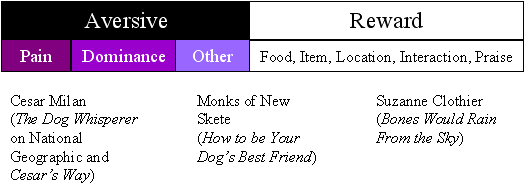
Basically, there are two classes of dog obedience training:
- Reward obedience training (give/remove something that our dog likes), and
- Aversive obedience training (give/remove something that our dog dislikes).
Reward Obedience Training
With reward obedience training, we first identify what our dog likes. Then, we encourage or discourage various behaviors by granting (positive reinforcement) or taking away (negative punishment) access to these rewards.
For example, when our dog sits, he gets a dog treat. If our dog is calm, he gets to interact with other dogs. We stop our dog from chewing on shoes, by redirecting him onto a Kong toy. Which rewards work best, depends on our dog’s personality and on his breed.
My Shiba Inu, for example, is a hunting breed and he is very motivated by chasing games. He also likes to explore new environments, and interact with other dogs. I will often use these as rewards while training him.
One common misconception is that we will not be an effective pack leader if we only use reward obedience training.
This is FALSE.
Pack leadership is most effectively achieved through the control of resources. We teach our dog that he gets the things that he wants most, such as food, toys, access to locations, and access to pack members, by following our lead.

Reward Obedience Training – The Good

1. Reward training helps to build a strong relationship based on trust.
Reward techniques teach a dog that all good things come from us. To get what he wants, he must first do what *we* want. Since we are viewed as a source for all of his needs, our dog will naturally gravitate toward us.
In addition, a dog learns that he has to work for his own keep. This engages him in interesting activities, helps him stay sharp, and helps to build confidence.

2. Reward training will not damage our dog either physically or mentally.
With reward training, the worst that happens is the removal of a reward. In contrast, physical aversive methods can cause damage to a dog, especially when not implemented properly.
Long term use of leash corrections may cause harm to our dog even when properly applied.
3. Reward training helps to create a dog that is happy and eager to work.
When we only use reward methods, our dog will be eager to work because work time means reward time.

Reward Obedience Training – The Bad

1. Reward training may not always solicit a prompt response to our commands.
For some dogs, a reward may not be as strong a motivator as an aversive stimulus, such as pain or fear.

2. . Reward training may sometimes require us to think outside the box.
With reward techniques, we may need to get creative and come up with our own strategies for motivating our dog. This is especially true when we are trying to stop bad behaviors because our dog may derive more enjoyment from the bad act.
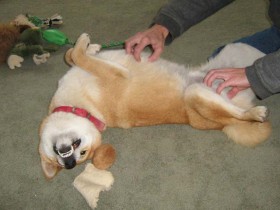
3. Reward training may require that we bring along some treats or toys when on walks and outings.
This can be an inconvenience. However, we can also use the environment, and the objects around us as incentives. All it takes is a bit more imagination, and a bit more understanding of our dog.
4. Reward training may cause our dog to gain weight.
Obesity can sometimes become a problem if we give our dog too many treats. I easily avoid this by using my dog’s regular food rations as part of his training rewards.

Aversive Obedience Training


I divide aversive obedience training into three classes:
- Pain based (e.g. leash correction, muzzle slaps, ear pinch, shock collar);
- Dominance based (e.g. alpha rolls); and
- Other – which includes making loud noises (e.g. shaking or dropping a can of pennies, loud horn, clashing pots), using unpleasant smells (e.g. spraying bitter apple on furniture, spraying citronella on muzzle), using unpleasant sensations (spraying water on muzzle, dumping water on body) or anything else that our dog dislikes.
Different aversive methods may place more or less stress on our dog. In general, pain and dominance based methods are the most stressful.
With aversive obedience training, we encourage or discourage behaviors by applying (positive punishment) or stopping (negative reinforcement) an unpleasant stimulus.
For example, if our dog breaks from his stay before we release him, we give him a leash jerk. If our dog starts biting on the leash, we give him a leash jerk, or spray water on his muzzle until he stops. If he jumps, we give him a leash jerk or knee him.
Cesar Millan, one of the most popular dog trainers on television, uses mostly aversive obedience training. Millan has a lot of confidence, as well as a natural talent for reading dogs. This is very important when applying aversive techniques because if they are not implemented properly, they may cause physical and mental harm.
There are a variety of other trainers that use a combination of both reward and aversive techniques, such as The Monks of New Skete.

Aversive Obedience Training – The Good

1. Aversive training may get more consistent and prompt responses to commands.
Many dogs will perform a Sit, Down, or Stay, consistently and quickly because they do not wish to face the stress of an aversive stimulus. Once we get consistent and prompt responses from our dog, we can give him more freedom and let him participate in a wider range of activities.
2. Aversive training may show results in a shorter time-span.
As described above, dogs can be very motivated to avoid pain and threats. We will probably start to see results in a shorter period of time compared to reward training.
3. Do not need to carry around rewards such as treats or toys.
We always have what we need.

Aversive Obedience Training – The Bad

1. Aversive training may cause loss of trust.
One of the most dangerous aspects of aversive techniques is losing our dog’s trust. If we over-correct our dog, he may start to associate us with the painful aversive stimulus, and lose trust in us.

2. Aversive training may encourage aggression and other unwanted side effects.
If we do not implement an aversive method with the proper timing, force, and redirection, our dog may develop aggression toward us and other people. A recent University of Pennsylvania study shows that if we are aggressive to our dogs, they will be more likely to develop aggression issues.

3. Aversive training may injure our dog if not implemented correctly.
Incorrect implementation of some of these techniques may cause physical harm to our dog. It may also cause physical harm to us and others, when the dog responds to the aversive stimulus with aggression.
4. Aversive training may become ineffective once our dog gets habituated to the stimulus.
If we overuse an aversive method, it is very probable that our dog will become habituated to it (e.g. he becomes used to the pain). Once this occurs, the dog will be less motivated to respond to our commands because the pain or aversive stimulus is no longer a strong enough deterrent.

Dog Obedience Training
Carefully consider which techniques are most suited for you and your dog. Be flexible and do not be afraid to change approaches if the current methods are ineffective, or start to cause aggressive dog behavior.
There are four dog obedience training choices:
- Mostly aversive training with little praise and few treats (Cesar Millan).
- Only reward training (Suzanne Clothier, Patricia McConnell, Ian Dunbar, Victoria Stillwell).
- Mixture of aversive and reward training (Monks of New Skete);
- Only no-pain and no-dominance aversive methods, combined with reward training.
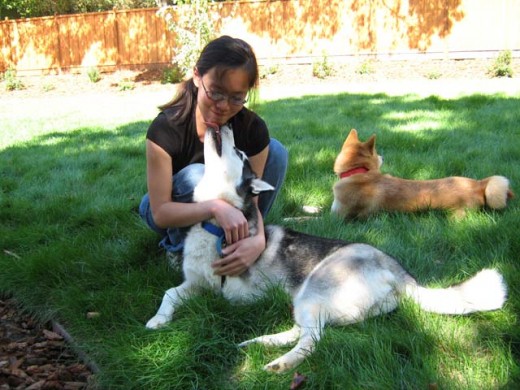
My friend thinks that when her momma dog bits the puppys by the throat that she hurting them is that true
“Mama dogs have very accurate control of the force and placement of their bites. This is why mama dogs do not accidentally hurt their puppies when they hold, carry, or correct them.
In fact, all dogs have accurate control of the force and placement of their bite. When a dog is young, he learns from his mother and litter-mates not to bite too hard on each other while playing and interacting. That is why puppies should not be separated from their mothers and siblings until they are at least 8 weeks old. Otherwise, they will miss out on this very important lesson.”
https://shibashake.com/dog/just-like-a-mama-dog-biting-on-her-puppys-neck/
I am curious how and if you gained your shibe’s trust back after using aversive training?
I’ve been raising my puppy (8 moths old) on aversive training techniques and I can see a significant distrust he has in me. He has his moments where he will listen to me and appear to like my attention. Though, some times when I walk too quickly towards him or make a quick movement he’ll tuck in his tail and hunch over scared. Then, he will sometimes show his teeth or growl at me when I proceed to pick him up or try and put him up (time-out). I’ve been trying out reward training and he has learned a few tricks like sit, paw, down, etc. Though, he’s still scared of me. Also, he will come to me for a reward and then dart off to someone else who isn’t even calling him.
Have I damaged my relationship with my puppy? I just want him to be a good dog and I read your post about caring about what other people thought than your dogs feelings and I feel that was my error. I was so caught up in trying to get him to be a model dog and ignored how he felt.
I’ve just had an awful experience with a demonstration from a company – Sit Means Sit who came out and put a shock collar on my 13 lb Basinje Terrier mix. She’s essentially a good dog – just needs more consistent training – Im the one who needs training here. Probably reward training will work for her? Has anyone else heard of this company?
From what I see (now) on the internet, they are a franchise operation – training people in 21 days to train dogs with a shock collar – including puppies! There are awful reports about them using collars on both groins and necks, turning them up much too high. My dog came away from this short demonstration afraid and with an inflamed, red neck. She did not eat for 2 days – I ended up taking her to the vet.
My vet was shocked at the use of this collar on the very fist visit.
What do you think?
Thanks for your feedback!
Kate
I am not a fan of shock collars. Here is why.
The dog training area is not regulated well (if at all), so it can be a challenge to find a good trainer.
More on what I did while looking for a trainer.
There is also a lot of conflicting information out there on dog behavior, so I had a really difficult time sorting through stuff in the beginning.
More on where I go to get information on dog training and dog behavior.
Great summary. I consider aversive and reward styles as two extremes on a continuum. I think aversive taken to the extreme is intimidation and abuse. Reward taken to the extreme is bribery. Can be compared authoritarian vs permissive parenting and teaching styles. Neither extremes gain respect.
Hi there,
I am a first-time shiba inu owner preparing for my puppy’s arrival in a few weeks. I’ve been researching a lot and am up to the obedience training part of my reading. I’ve read that not many people recommend using aversive training as it may develop some aggression problems in the future.
So now I am a bit confused at how I might teach my puppy “no”, and to not repeat his mistakes (without having to use a spray bottle or a collar tug). I’ve read that shiba inus are generally independent and am afraid that a simple “no gesture” and ignoring him for a few minutes may not work. Wouldn’t my puppy just shrug it off and go about his own way?
In the future case where I may catch him in the act of peeing where he is not supposed to, how can i make him realize that that is a mistake without getting physical? While reward training is great for a dog that does what you want it to, how would it work to reinforce the “no” command?
(Apologies for the loaded question!)
In this article on dog discipline, I talk about the dangers of pain-based aversive techniques, and how I teach my dogs to follow house rules.
Here is an article on how I trained my Husky puppy. I talk about how I use “yes” and “no”, how I tie the words to consequences, and how I stop undesirable behaviors.
When I first got my Shiba Inu, I started with aversive methods. It did not go well with Sephy, and ultimately, made him very sensitive to handling, lose trust in me, and develop even more behavioral issues. Here is more on the risks of aversive training.
Here is what I do to potty train my dogs.
A bit more on how dogs learn.