Dog aggression is an overloaded word.
It can mean anything from staring, jumping, showing teeth, lunging, growling, barking, or the terrible B-word – biting.
Usually, aggression is used to describe dogs that overact to a stimuli (e.g. another dog, a stranger, food).
Reactivity is a new, perhaps less negative term, coined to describe the same behavior. Some trainers use aggression to describe dogs that overact as a result of dominance and reactivity to describe dogs that overact as a result of fear.
These terms, however, are just labels, and it is not useful to overly focus on which label to use.
The important thing is to recognize extreme behavior in our dogs, which causes us to lose control.
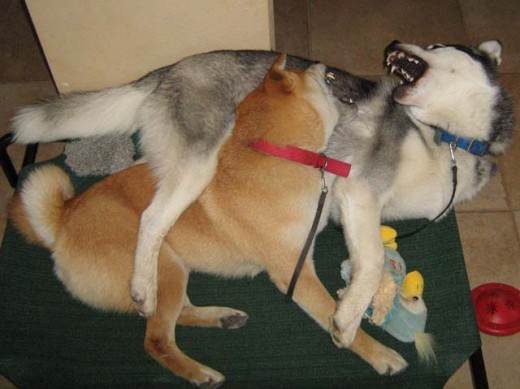

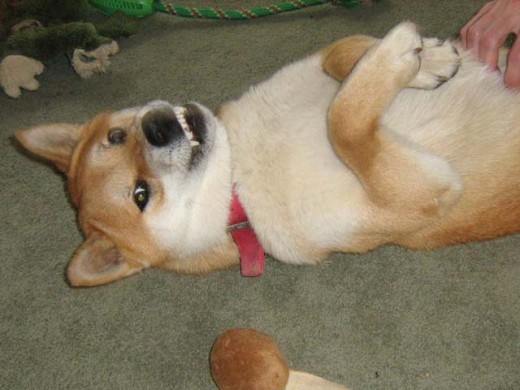
What constitutes extreme behavior varies from person to person, and is dependent on context. Mouthing and showing teeth in one context may just be play (top and right), while in another, it may be dangerous.
A problem only arises when the human/owner is not in control of the situation.
If your dog is biting you and causing puncture wounds, it is best to seek help from a professional dog trainer.
My Experiences with Dog Aggression

I was very embarrassed, shocked, and worried when my Shiba first showed signs of aggression. It happened four days after we brought him home (at 10 weeks old), when we took him to the vet.
The vet was very afraid of him and had to muzzle him to do an examination. She later recommended that we return him to the breeder. I never visited with this poor vet again, but at the time it was very difficult not to be embarrassed, and try to show that we were good dog parents by scolding and punishing our Shiba.
Many of my neighbors also gave us the ‘you are such a bad dog parent‘ look.
Because I was so embarrassed I made some very bad mistakes. The worst was using alpha rolls and other aversive techniques including leash jerks with him. My embarrassment also caused me to get angry, and frustrated with my dog.
I was jealous and hurt when my dog would behave better with other people. After all, I feed him and take care of him most of the time, why should he misbehave most with me?
Although it is very natural to have such feelings, they are very detrimental to helping a dog with his reactivity or aggression issues.

Dog Aggression and Love
Remember that your dog’s behavior is a result of behavior conditioning, and not from lack of love
It is natural for us to place our own, very human values and expectations upon our dogs but that is not the way they think.
Dogs respond to conditioning (classical and operant). Dogs will repeat behaviors that have good results and reduce behaviors that have bad results.
What constitutes a good or bad result can sometimes vary from dog to dog. If your dog is showing aggressive behaviors that are continuing to escalate, then he is inadvertently being rewarded for that bad behavior.
- Does he get to go on a walk when he jumps up on you and makes a pest of himself?
- Does he get to smell the other dog by whining loudly and lunging?
- Does nail clipping stop when he mouths or bites you?
- Do you back away when he growls and shows teeth?
If so, then your dog is getting what he wants through aggressive behaviors and will continue those behaviors.
Once we accept that our dogs are not acting out of hate, jealousy, or some other human emotion, we can move on and start reshaping their behavior by changing the consequences of their actions.

Dog Aggression and Other People
Do not worry about what strangers think. Your dog’s welfare is a lot more important.
Actively watch out for feelings of embarrassment, anger and frustration and try to redirect yourself to a more positive frame of mind. Rather than focus on the judgment of strangers –
- Think about the fun you had with your dog just this morning and how cute he looked with cheese bits all over his muzzle and his tongue hanging out in a goofy smile.
- Carry some happy pictures of your dog with you to help redirect your negative feelings.
- Remove yourself and your dog from the unpleasant stimulus as soon as possible.
Dog Aggression and Breed
Some dog breeds may be more prone to reactive or aggressive behaviors. Breeds that are strong-willed, stubborn, and independent will have a higher propensity for challenging you, and displaying aggression in that process.
Breeds that have a strong prey drive may easily become over-excited when they spot prey (e.g. squirrels, cats) and redirect that energy onto you if you thwart their instinct to chase.
Similarly, a strong protective drive may result in using aggression to guard territory, food, toys, or other resources.
More primitive dog breeds often have a lower reactivity threshold. I.e., they may easily go rear-brained when excited, stressed, or fearful.
Make sure to take your dog’s temperament and natural breed instinct into account while retraining his aggressive behaviors.
Dog Aggression – What to Expect
Dealing with dog aggression can be difficult, and may take a long time to fix, but …
- The rewards are well worth the trouble.
The journey will reveal many things not just about your dog, but also about youself. In the process, you will develop a special relationship and strong bond with your dog – and that in itself is priceless. - Things will get better.
Many dog owners are going through the same thing, and their dog’s behavior has and continue to improve. - Your dog will challenge you less as he matures.
… but he may keep challenging you. That is one of the joys of dog ownership 😀
When the world says, "Give up,"
Hope whispers, "Try it one more time."
~~[ Author Unknown ]
If you are having aggression issues with your dog, know that you are not alone. I had many aggression issues with my Shiba Inu.
There are also many touching stories from the Toronto Shiba Meetup and Dogster about dealing with dog aggression.
More on Aggression
- Aggression: The Humane Society of the United States
- Behavioral View on Dog Aggression
- Desensitizing your Dog with Clicker Training
Canine Body Language
- Calming Signals: An article about Turid Rugaas.
- How to Interpret Your Dog’s Body Language, Facial Expressions and Vocalizations
My 2 yr old Pit Bull/ Dashound mix barks at doorbell. I pick him up so he can smell the new person coming into his home. But some people, just one so far, he did not like for some reason. He nipped at his shirt. He’s NEVER done that before. He’ll smell them and I put him down and he walks away or watches repair man or whatever this person is here for. And as far as settling down by one yr old.. Um, NO!! He is so, so active. He plays with our 8mth old Siberian Husky. We have 2 cats, all I need to say is ” Leave it” and he will walk away. Or I make this sound with clenched teeth it sorta sounds like chu chu chu. As soon as he hears that he stops. I am disabled and he is a registered emotional support dog. But I can’t get out and walk him or socialize him. When I did he has an extreme amount of energy he’d just tackle or roll or jump right over other dogs. He is neutered. He does burrow under covers. He never makes a mess in house when left alone 4 hours. He is not bone dominant, has no toys due to him being an aggressive chewer. I don’t know why he did that to that repair man. Never ever before. He loves to lick everyone. Give kisses. So I’m dumbfounded. He listens to commands. Well trained. Except for the socialization part. I’m on a fixed income and trainers I definitely can’t afford. Help!!!
Hi I adopted a 4yr old bichon poodle and when I first got him he was so nice and playful but now he is starting to growl at me if I start moving around the house fast or if my son is sleep he doesn’t let me get near him Or even try to wake him I don’t know what to do because he is starting to try and run the house with aggression please help me
We recently adopted a 18 month old pit bull from paws. I gave him a bath yesterday and he did ok. He wasn’t happy about it but let me give him one. Today when I got home from work I noticed that he was having an allergic reaction to fleas. We went and bought some things to get rid of the fleas and gave him Benadryl. I decided to give him another bath with the oatmeal and aloe shampoo to try and relieve some of his pain. When I got him in the bathroom and turned the water on he tried to attack me. He hasn’t shown any signs of aggression since we got him. Any guesses on why he tried to attack me?
I have a 2 month 15 days old boxer male dog . I just don’t know what is wrong with him . He is going through is teething problem I know dat so we have given him toys n bones bt he started biting me n my family .I used to think he is just a puppy and it’s natural bt then I reliased it is mandatory to stop him because he bites so hard that it bleeds a bit n there is a long cuts on my hands and feet. One night he was playing n we weren’t allowing him to go out so he lay down in attacking mode and attacked on my leg and that pain was literally much. Now we started scolding her with newspaper banging on floor to make a loud noise and say no but he didn’t really got affected by that .it seems that he doesn’t got affected by it then we tried scolding him on his face verbally by showing a finger that he is doing wrong bt he would then try to jump on me scare me and bite me whenever I tell him to get down from bed he would get down when I have told him by yelling 2 – 3 times bt then he would come runing n hold my feet and bite me . Then I would say no n he would go away sometimes or try to bite more sometimes . He has learned the sit command and when giving food he listen to me n would follow my sit command and when I tell him not to enter a particular room he woul even follow day bt for few seconds as distance between him and me increase s . My father takes him on walks we socialize him . He meets everyone excitedly by jumping and licking them . Bt he does dis with strangers and get excited by seeing amyone or dog bt once he got familiar with a particular person he started a bit of biting . He sometimes won’t even let me pick him up if I touch him to get hold of him he would turn back to bite me or swap I don’t know as I m not sure what he he does he let me hold himself when he needs me like when he need me to get him down the stairs for a walk . He is also I guess middy coz he sometimes won’t let me to touch his forehead while I m loving himor petting him he would just move his forehead in head in air n try to get hold of my hand and then turn his head in other direction as he is trying to ignore me and he cries and then barks at us when we won’t allow him to have food when we are having our food and then he reliased he won’t get he settles down . Once my mom was loving her like moving her hand on his back as he came running towards her as she have came to the house after few hours then suddenly moved back with a jerk biting so hard on her nose that it bleeded a lot . He always licks is showing his love when we come home by then while licking only he starts biting on our face n hand n it’s very sudden we play with him by we can’t lay on floor or sit while he is there as he would jump n start biting and growling he uses to growl a lot by now he does very few times I don’t know what is wrong with him is he being aggressive dominant or is it normal I m so confused about what to do
I can’t get my dog to stop pulling when walking. He is so strong I can’t handle him.
Hi Ursula,
I was having the same problem with my dog and was told about ” the gentle leader” – it’s a collar that goes around the dogs nose and behind her ears. It worked like a miracle!!! I am no longer afraid to take her for a walk.
Get an extra long leash tie it around your waste. Start running. Change directions abruptly repeatedly DO NOT TALK TO YOUR DOG. Threat of the day with a shorter leash do the same as you go about your day. DO NOT TALK. After hours of this yoir dog will get sick of you Jr king his neck and hill start to watch what your doing instead of him watching you. Next day or the day after…. do it and at some point remove the leash and he should follow.
My dog just the past few months has been attacking other dogs. If does not matter if they are big or small. She will even attack dogs that she is familiar with. Why is this happening?
I am having the same problem…my dog tonight just attacked a female ….He is a male….I don’t understand this at all…..please let me know if you find out any info on this…..there is no blood shed just a lot of growling
I have a sixteen month old Staffordshire Bull Terrier mix. Good with dogs, children and people in general. However I do not trust her. She has growled/ barked at my sister twice. On both occasions my sister startled her awake and my dog jumped up barking and growling. I know what such breeds are capable of. Is there anything I can do, to make her less jumpy? I think this is called sleep aggression.
Hello there,
I have a 1 year old Black Lab/Australian Sheppard mix who has been displaying aggressive behaviour towards a dog we are dog sitting and our German Sheppard who he has previously never had a problem with and has grown up with as basically a brother. This is more evident when I (Mom) is home versus when he is home with someone else as well as when food or toys are involed. There has been some changes in reutine as of late, as the two of us went away to visit family for a week and came home to a new doggie visiter. He has also been dealing with some stiched in his eye from Entropia. I would like to think that this behaviour is a result of his discomfort and the change in routine. We have been doing our best to keep him physically and mentally stimulated and to send him on time outs in his crate when he starts scraps with the other dogs. I would really like to get your opinion on whether we are on the right track in regards to not encouraging such behaviour or allowing it to become a habit of his.