Why do puppies bite?
Unlike us, puppies do not have opposable thumbs, so they manipulate stuff with their mouths, in the same way that we manipulate stuff with our hands. New puppies or young dogs will try to put everything into their mouths, because they are curious about objects and their surroundings.
Therefore, puppy biting is normal canine behavior.
Puppies also play with each other through play-biting. When a puppy bites too hard during play, his siblings may yelp and stop interacting for a short duration. Biting too hard on an adult dog (e.g. their mother), may also result in an undesirable consequence. In this way, puppies learn social rules and boundaries.

There is nothing wrong with dogs or puppies biting each other during play, but it is crucial to teach them to be careful with their mouths when interacting with people.
A puppy who is not taught this lesson, may become a danger to all the people around him, including his owners. Play-biting with humans, especially seniors and children, may cause accidental injuries and ultimately result in forced euthanasia.
If our puppy is biting us or others in an uncontrolled way, it is best for everyone not to engage in rough play with him. Also, do not play games that encourage biting such as Tug-of-War.
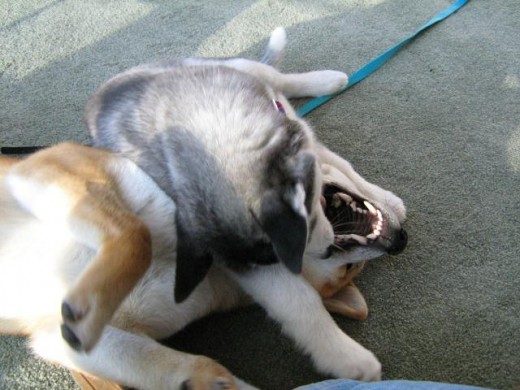
How to Deal with Puppy Biting
I deal with puppy biting by training my dog in three important areas –
1. Bite inhibition training
People have thinner and more sensitive skins than dogs do. Therefore, one of the first things that I teach my puppy is to control the force of his bites, especially when interacting with me and others.
2. Redirection and no-bite conditioning
When my dog bites on people, clothing, or unsanctioned objects (e.g. books, wires), I no-mark to let him know that it is an undesirable behavior. Then, I redirect his mouth onto something acceptable, and reward him for doing the right thing. In this way, he learns which objects are off-limits, as well as what he should do instead.
3. Excitement and self-control
An over-excited puppy, who lacks self-control, will tend to bite more often and with greater force. By managing my puppy’s excitement level and teaching him to control his impulses, I set him up for success, and reduce the number of instances where he engages in bad biting behavior.
An ounce of prevention is worth a pound of cure.
~~[Benjamin Franklin]
When dealing with puppy biting issues, I always try to stay calm but firm. I do my best to catch problems early on, and fix them before they escalate in degree and frequency.
If a dog is causing puncture wounds, or escalating his aggressive biting behavior, it is best to get professional help as soon as possible.
In this article, I discuss bite inhibition training and no-bite conditioning. For more on managing a puppy’s excitement level, please refer to Managing Puppy Excitement and Self-Control.
Bite Inhibition


Some dogs may have low bite thresholds. This means that they resort to biting or aggression even with fairly low, seemingly harmless stimuli.
One of my dogs, a Shiba Inu, can get mouthy when he is excited or frustrated, when I restrain him, when I stop him from doing something, and much more. Because of this, it is extremely important to train him to have good bite inhibition.
I start bite inhibition exercises as soon as I bring a puppy home. Even though puppy teeth are sharp, a puppy does not have the jaw strength of an adult, and is not capable of doing as much damage. Once my puppy has a soft mouth, I train him to stop biting on people.
Hand-feeding is a good way to teach our puppies to control the force of their bites. I hand-feed my puppy at least some of his kibble every day. If he bites too hard when getting his food, I do a sharp ouch or yelp, and ignore him for a few seconds. This teaches him that if he bites too hard, the food stops.
If my puppy is taking food from me gently, I praise him and keep the food coming. Often, I will combine hand-feeding with puppy obedience training and dog grooming sessions. Hand-feeding can also help prevent food aggression issues, so I continue this practice throughout my dog’s life.
We can also get Ian Dunbar’s book After You Get Your Puppy, for an overview of bite inhibition training.
Initially, Dunbar may come across as somewhat alarmist. We may feel that if we do not meet his somewhat unrealistic dog socialization and puppy training demands, things are going to go badly. I just try to ignore the alarmist talk, and focus on the bite inhibition and handling exercises, which are quite useful.
I am very thankful that my puppy (now adult dog) has a soft mouth. Because my Shiba Inu has good bite inhibition, we were able to solve many of his subsequent issues, which would have been difficult to deal with if he were biting at full strength.

When Our Puppy Bites …
When our puppy bites, it is important NOT to jerk our hand away. If we jerk away, we will likely get scratched. In addition, sudden and quick movements may make our puppy think that it is a fun game. This rewards the biting behavior, and encourages him to bite on us even more.
In the worst case, quick movements can activate a dog’s prey drive, and encourage aggressive behaviors. Therefore, it is important to control this reflex action, and stay still. In addition, I give a no-mark or yelp as a puppy might do to his litter-mates, when they are playing too rough.
I usually yelp when it is an accidental dog bite, for example when my dog gets his teeth on me while taking food out of my hand. Yelping is also appropriate for puppies that are still learning the rules. Otherwise, I use No for adult and adolescent dogs, who should know better.
After the no-mark, I always follow-up with a positive command, e.g. redirect him onto a toy.
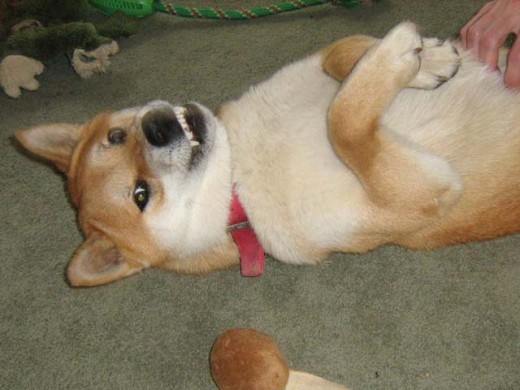
1. Redirect Our Puppy onto a Toy

This technique is especially useful for an untrained puppy. It lets him know that it is ok to bite on a toy, but not ok to bite on people.
For example, my dog gets excited and starts biting when I scratch his tummy. Therefore, I used that as a training exercise to get him to bite on a toy, instead of on my hand. Since I can start the exercise anytime I want, I control the environment and make sure that I have multiple soft toys nearby for use. I make sure to reward my dog very well with food and affection when he redirects, so that I further reinforce the behavior.
A toy can also be useful for those cases where the puppy is losing control, and getting a bit too excited or frustrated. Giving him something to redirect his excitement or frustration at, may help to calm him down.
If I do not have a toy handy, I can also redirect by giving my puppy an alternate and simple command that he knows very well, e.g. Sit.

2. Withdraw Attention and Affection
Often, a puppy starts to bite at us because he wants to play or interact. Therefore, if my puppy does not respond to my redirect, then I withdraw my attention and affection. I do this by standing up, folding up my arms, and ignoring him. I make sure not to give any eye contact, not to talk, and not to engage him in any other way.
This is also called a timeout lite.
By doing this, my puppy learns that-
Out of control biting and jumping = No play, no attention, and no affection,
Gentle interaction = Play continues, food rewards, and extra attention.
Sometimes, my puppy may get too excited and escalate his behavior by biting on feet, or jumping and trying to bite on clothing. This is something that I absolutely do not allow because it can be very dangerous, especially with children and the elderly.
If my puppy escalates his behavior, I no-mark, say “Timeout”, and take him to a low stimulus timeout area immediately.
NOTE – In general, I try to set my dog up for success by managing his excitement level. In this way, I keep timeout-necessary episodes to a minimum.
3. Timeout
Most dogs value their freedom to roam around the house and backyard. Dogs are also pack animals, and like being with both human and canine members of the family. Since a timeout takes away both of these things, it is an extremely effective method of dog discipline.
When giving my dog a timeout –
- I make sure to put him in a really boring room, with no windows that he can reach. Currently, my dog’s timeout area is the laundry room.
- I check that the room is safe, and contains nothing that he can chew, play, or interact with in any way.
- Finally, I ensure that nobody gives puppy any attention during his timeout period.
It is better not to use a crate for timeouts. Crates are useful for transportation, management, and more. Therefore, I ensure that the crate is a happy place, where my dog feels comfortable going to for some peace and quiet, for sleep, and to chew on his favorite toy.
I find that a timeout is the most effective way to stop my dogs from biting. However, I only use it when my puppy is deliberately acting out, and not for accidental bites.
Initially, I start with a short 1 minute timeout. If my dog continues to bite right after he comes out, I return him to the laundry room for a much longer period of time (about 15 minutes). Be flexible with the timeout duration, and adjust it according to our dog’s age, temperament, and behavior. Some trainers do not believe in long timeouts, while others may ignore their dogs (timeout lite) for hours.
Do not use timeouts for training mistakes or lack of motivation.
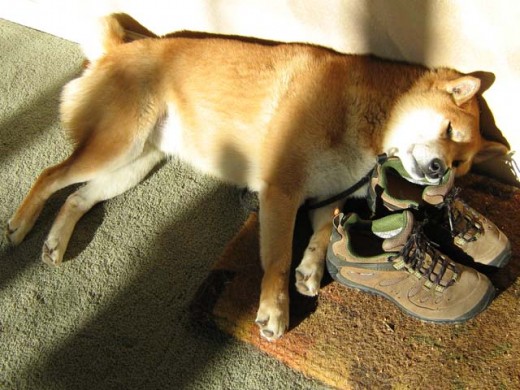
How to Stop Puppy Biting
Some trainers suggest using aversive techniques to stop dog biting. For example, one suggested making my hand into a fist (so my fingers are safe), and then pushing my fist gently in when my puppy bites. This is uncomfortable for the puppy, and he will likely release our hand.
While it did get my puppy to release my hand, it did not reduce his biting behavior. In fact, my dog responds badly to any aversive methods. Doing this made him want to bite on me even more, because he got a reaction, and now has something (my fist) to fight with.
The same thing occurred with spraying water on his muzzle; he just started attacking the water bottle.
Ultimately, aversive techniques were not very effective with my dog, and caused even more behavioral issues. With aversive methods, it is difficult to trick a puppy into thinking that the bad stimulus is not coming from us. This can compromise a puppy’s trust and weaken our bond with him.
Instead, when my puppy bites,
- I first use a no-mark, for example, No or Ack-Ack to let him know that it is an undesirable behavior.
- Then, I redirect him onto a toy or give him an alternate command, for example Sit. If he stops biting and follows the command, then I praise him and reward him with attention and a fun game.
- If he continues to bite, I start with a timeout-lite by first withdrawing my attention. I do this by standing up, folding my arms, and turning away from him.
- If he escalates his behavior and starts to jump or bite on my clothing, then I quickly remove him to his full timeout area.
I always try to set my dog up for success by managing his excitement level. When he starts biting, I try to redirect and turn things into a positive learning experience. I only escalate my response when I absolutely have to, and I try my best to minimize those instances.

I have a corgi-heeler mix pup who is about 4 months old and we’ve had her for a month; I’ve been training her but we have many issues with her that seem to be getting worse. One is that she doesn’t like going on walks and will spend the whole time trying to run back home– she doesn’t like being outside at all unless its in the woods while I go to play disc golf with my dad. When I take her out, she immediately runs back towards the back door after peeing. I’ve tried to initiate play and she just stays at the door. She also barks a lot which isn’t surprising considering she is mixed with corgi, but there is lots of aggressive barking towards my dad whenever he walks in the room and although she’s started trusting him a little more, she still barks. She also has a biting problem which I think is because shes so hyper- shes probably constantly so hyper because I have to leave her in her kennel all day since I have school and no one else in my family is willing to do anything before I get home. She’s also skittish and when she bites, I tell her no and put a toy in her mouth but she resorts to growling and attacking me whenever I do this. She’s overall not good with many people. Sorry that this was wordy, but you guys seem to know what you’re doing and I really need help. I want her to be social with everyone and outgoing and friendly and I want to be able to take her outside without her being miserable every second she’s out there.
My wife has a female German Shepherd-Siberian Husky mix about 7 or more months old. She’s from the animal shelter and was picked up by Animal Control roaming the streets. A family adopted her but returned her shortly because “she was too destructive.” Understandably, she has numerous problem behaviors. Some are improving but some are intensifying. Her tendency to chew on things that are not appropriate, such as brand new 4″x4″ painted redwood posts that hold up the roof over our wide front porch is one big one. My wife spent a good deal of money having a carpenter replace the existing posts and other wooden trim. He did a wonderful job and damage to the existing posts was why. Another of our dogs had chewed on one post when she was a puppy, and then the new dog began chewing on several of the 5 posts. Our homeowner’s insurance carrier had did a inspection of the property from the street and taken pictures, resulting in asking us to make repairs or our policy would not be renewed. It has only been the 5th day since the carpenter finished his repairs and I caught the new dog chewing on the one post before we had even had a chance to take pictures and submit them to the insurance company so that we would be able to renew our policy when the time comes. Is this behavior that can be corrected, or is it something that no amount of chew toys and training can fully correct? She also has other issues such as separation anxiety, bullying the other, smaller dog during play, and of course, chewing on furniture items. The cost of damage already has exceeded $2500 if you count the loveseat, desk and outdoor porch structures. My wife got this dog while I was hospitalized, and I had objections due to her size and breed. I’m in very poor health and cannot do much with the dog myself. It is also difficult because it is a non-stop problem that I am stuck to deal with while she and other family members are away from home. I had told my wife she could get a small, female poodle when our last dog passed away from old age. I have experience with poodle and mixed-poodle breeds and have never had these kind of behavioral problems to deal with. And being disabled I do not have financial resources to constantly pay for repairs and new furniture. Please help, because my wife does not want to give up on her new dog, or admit that she made a poor choice with regard to my health and the smaller dog we already have. Thank you so very much for any suggestions.