Sometimes it can be difficult to find a good dog trainer that is knowledgeable, fits our personality, fits our dog’s personality, understands dogs, and is a good teacher.
I had a difficult time finding a good dog trainer for my Shiba Inu.
He is not an easy dog to handle, and most trainers that I visited initially were not very familiar with the Shiba Inu breed.

Finding a dog trainer


- Get a list of all the dog trainers in our area. If we live in the United States, we can use quickly generate this list using the Association of Pet Dog Trainers search tool.
- Decide which dog training style most suits us and our dog.
There are generally three groups of dog trainers –
- Those that mostly use reward techniques,
- Those that mostly use aversive techniques, and
- Those that use a combination of the two.
Here are the pros and cons of the different dog training styles.
- Visit the websites of all the dog trainers on our list, and filter out the ones that do not use the dog training techniques that we think are appropriate.
- Call up all the trainers that are still on our list and quiz them about the dog training techniques that they use. Tell them some of the problems we are facing with our dog and evaluate the answers that they give us.
- Pick the top three trainers based on our phone conversation, and set up a dog evaluation session with them.
Most trainers will want to evaluate a dog first before coming up with a training program. These are usually private evaluation sessions that last from 1-2 hours and cost from $50 US to $100 US. These sessions are also useful for evaluating the trainer in action with our dog.
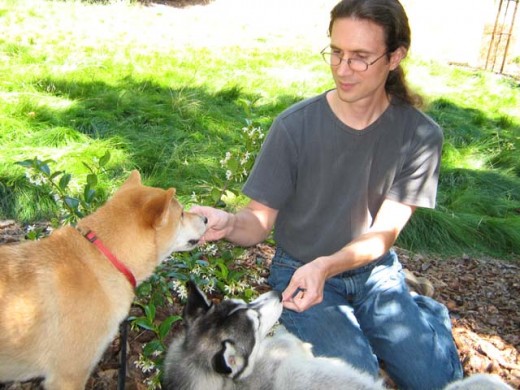
Do not just follow whatever a trainer tells you
The dog training profession is not very well regulated so we may run across some mediocre or bad trainers before finding one that suits us.
If you feel uncomfortable about particular training techniques, ask your trainer a lot of questions, and do some online research of your own. If the trainer is rude to you or does not want to answer your questions, then leave and find another trainer who will actually work for his pay.
Remember that you are the boss. You pay them, not the other way around.
Do not be afraid to terminate training if you discover in the middle of the program that the trainer is not knowledgeable, does not suit you or your dog’s temperament, or is making your dog anxious and unhappy.
It is also a good idea to ask a trainer what his policy is if we decide to terminate training early.

A great resource in my dog trainer search was my local SPCA.
I had very good experiences with the two SPCAs that I visited. Both of them had very knowledgeable dog trainers, and very reasonable prices. They were also very willing to accommodate my training requests, and had a variety of balanced dogs at the shelter that they were willing to use to help train and socialize my dog.
Often, the best teacher for a dog is another dog, especially with dog-to-dog aggression issues. While we may try to learn ‘dog’ to better communicate with our furry friend; a well socialized and balanced canine is not only extremely fluent in his native tongue, but knows when, and how to use it to achieve the most effective results.
Using other dogs is often an invaluable tool in dog training. Therefore, find a dog trainer with good access to other dogs, if you can.
In addition to the SPCA, dog trainers who are attached to a dog daycare or dog walking service will frequently have access to appropriate dogs that they can use in the dog training process.
Another possibility is to get help from our breeder. Good breeders know their breed well, and can usually point us in the right direction. They may even provide our dog with some good playmates.

Dog trainer vs. boot camp
Instead of hiring a trainer, some people send their dog to boot camp.
I have never sent any of my dogs to boot camp.
My poor Shiba got stressed from going to daycare once, for about 8 hours. He came back sick, depressed, stressed, and car reactive. I don’t think he would handle boot camp too well.
My opinion is that boot camps are risky.
We do not know what is happening to our dog during his time there, and there is usually very little transparency. A trainer once told me that she subdued a Shiba by giving him an extremely strong correction with a choke chain. Then, she held him down in a forceful alpha roll, loomed over him in a menacing fashion, and growled at him. The Shiba defecated and after that incident, he was very "well-behaved".
Even if my Shiba miraculously became well-behaved, I would lose a lot of hard-earned trust, lower his quality of life, and damage our relationship.
Finally, the training done at boot camp may not transfer to us.
- If we are still fearful of our dog,
- If we are projecting weak and unbalanced energy,
- If we are inconsistent in enforcing our rules, …
Our dog will return to his old ways.

My Shiba Inu trainer experiences
Shiba Inus are still not very common in the United States and it can be difficult to find a trainer that is familiar with Shibas.
Shibas are primitive, stubborn, and extremely strong willed. Therefore, it is best to get a trainer with a lot of Shiba experience, is knowledgeable of the breed, and has successfully trained them.

After over a year and a half of meeting with trainer types, I have finally met one who knows Shiba. She handled my Shiba very well and very correctly identified him as a "reaction junkie" (playing, chasing, or fighting are all rewards to him as long as he gets a reaction. The bigger the reaction, the better it is.).
Previous trainers who "said" they knew Shiba, but really didn’t, have alpha rolled him to detrimental results. Others were uncomfortable dealing with a dog that mouthed so much, would not surrender, and would be constantly trying to push their buttons.
Remember that if at first we don’t find the right trainer, find another one.
To get a quick feel for the trainers around me, I enrolled for classes in a variety of places, and visited with my local SPCA, daycare centers, and training facilities.
Here are more tips on how to find a good dog trainer from –
If you have more tips or stories about finding a good dog trainer, please share them with us in the comments section. Thanks!
I am looking for an experienced shiba inu dog trainer near me in Carmel, NY – Putnam County. Can you please send me some names of dog trainers for puppy of 6 months. She needs obedience training help. She is very independent and plays with her toys, does not bite, but is stubborn about walking – she wants to bolt due to her hunting instincts. She also does not like people to visit – she does socialize outside with strangers and other dogs, but not inside. I need some guidance about this breed and do not want to read about it online. There are different things that are confusing with various websites about this breed, I want to have a few visits with an experienced trainer with Shiba Inus and want to start at her 6 months age and not wait. I hope someone out there can respond.
Hi Susan, we have a 9 year old shiba female and a 15 year old Jack Russell, who has about a week to live, we wanted to make sure our. Emile was not left alone, we live in Spain currently and I met a breeder/ shower and we got to talking and long story short I ended up with two of his females who are not yet fixed and now in heat 3 weeks after arriving, they are mother and daughter 5 and 3.5 and had to come as a team. The younger female is like a wild animal and very timid. Our 9 year old has been pretty good EXCEPT when their is food involved. My husband dropped the treat bag and she got vicious and started a brawl tonight, the two dogs fought but my husband got the brunt of the bloodshed. Our older dog has also been running around snapping at their muzzles when they try to come in the house or move toward an area she feels is hers. Any suggestions?
Thank you Kate
My husband and I recently adopted a dog from the shelter and is pretty timid still so we’re thinking of having him see a trainer. I like the suggestion you made in possibly finding a trainer that has access to well behaved dogs to help in the training process, which I think would probably help in showing the dog being trained that everything is okay and is also an example. We will be doing our research into what kind of trainer will be best for Buddy and possibly even one that has other dogs to be partners in the process.
My dog use to be very sweet until she went into heat for the first time now she bares her teeth and growls at me when I try to pet her its terrible she is my best friend any advice would be great thanks
Do you know any Shiba Trainers in the Orlando, FL area?
Sorry, I do not. This article from the ASPCA has more on what to look out for while finding a trainer-
http://www.aspca.org/pet-care/virtual-pet-behaviorist/finding-professional-help
Hi I am searching for help with my shiba. He is 6 mos old and recently had an encounter with a small snapping turtle. He did not get bitten but scared him terribly when the turtle lunged. Now he is scared of everything. Going on walks is supremely difficult now. He used to love exploring and playing in the grass, even though the encounter happened on pavement he bucks at the thought of going in the grass. I live in Missouri and not many people familiar with shiba’s. any insight would be appreciated. It’s heart breaking but if this is permanent then I will do the best I can.
Thanks
Sephy and I have not come across a snapping turtle before :D, but here are some things that I do with my Shiba to get him interested in exploring-
1. I play the Find-It game with him.
2. I slowly reintroduce him to the scary environment. For example, I start walking in the backyard with games and rewards, then we move on to the frontyard, then we very slowly walk in quiet areas close to the house, etc.
3. I take him to new hiking trails. He is very excited about exploring a new environment. However, this would depend a lot on the dog. A new environment may be scary for some dogs, but on the other hand, the dog may not associate the new environment with the scary stimulus from the old environment. I try to start with a quiet, low stimulus area, and take my dogs home if it seems like the new environment is too much to handle.
4. I do desensitization exercises on things that he is afraid of. For example, my Husky was afraid of the garbage truck so I first desensitized her to the sounds of the garbage truck, then I very slowly did exercises with her during days when the garbage truck came around.
For professional help, this is where I go-
http://www.apdt.com/pet-owners/choosing-a-trainer/
Susan, I am hoping this response finds you well. I am in need of help with my new Shiba pup! She is 11wks old as of yesterday and I am trying to find the best trainer for her. I already sense her personality and it changes with the slightest of new experiences. I live in Kansas City and noticed you’re from Missouri. Any insight would be greatly appreciated! If you don’t mind responding, even if your experience has turned out that great. Thank You so kindly!
Kelly
How can I make are 8 week puppy stop biting?
Some of my experiences with my dogs and biting.
Setting up a consistent structure, routine, and rules at home also helps. Here are a few more puppy biting tips.
I need to find a trainer in Carson City Nv..Im having problems with my shiba inu can you suggest anyone
Hello Kevin,
I have only worked with trainers around where I live and do not know any in Carson City.
The article above outlines what I did to find trainers for Sephy. We also visited many local dog daycare centers as well as our local SPCA and humane society. Visiting all these places was useful in getting a lay of the land in terms of what was generally available. The people at the SPCA and humane society were very helpful with our questions and they had some good trainers as well.
Finally we also visited with a few registered Shiba breeders in our area. We wanted to meet with veteran Shiba owners and let them have a look at Sephy to see if his behavior was typical Shiba (before this, many people had told us that he was very extreme even for a Shiba). Those breeders took a look at him and said that yup – he is a typical Shiba! That was good to know! 😀