Like us, dogs have anxieties and fears. A dog’s anxieties, may not be the same as our own anxieties, but they cause stress and physical reactions just the same.
Some common dog anxiety problems include –
- Separation anxiety – A dog gets anxious when left alone.
- Noise anxiety – A dog becomes fearful when exposed to loud or unusual noises. Some examples include fireworks, thunderstorms, garbage trucks, and more.
- Travel anxiety – The car is like a den, but dogs are unaccustomed to moving dens. Therefore, they may become unsure and stressed over something so new and unexpected.
- Confinement anxiety – A dog gets anxious when he feels trapped or confined. If a threat should arise, a confined dog may be unable to escape or flee.

Symptoms of Dog Anxiety

When dogs are anxious, they may engage in repetitive or displacement behaviors to relieve their stress. For example, when we are anxious, we may pace, bite our nails, or play with our hair.
Dogs may also pace, groom, and more. Some dog anxiety behaviors may lead to property destruction, may cause us harm, or may simply be undesirable to our human sensibilities. This may include –
- Non-stop barking.
- Chewing up furniture, walls, shoes, garbage, and anything else in sight.
- Pooping and peeing in the house, crate, or other confinement area.
- Eating his own poop.
- Aggression toward people, dogs, or other animals.
Punishment or aversive techniques will do little to stop these anxious dog behaviors in the long-run, because punishment does not address the source of the problem, which is the dog’s anxiety. In fact, suppression of these displacement behaviors, through pain and dominance methods, will make the problem worse, because pain increases stress and uncertainty.
Below are some common ways on how to deal with dog anxiety.
1. Desensitization Exercises

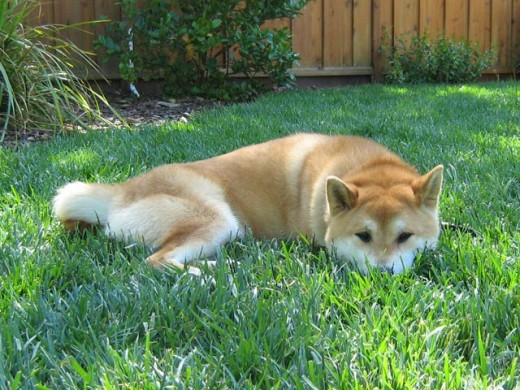
One of the best ways to help a dog deal with his anxiety issues, is by slowly desensitizing him to the problem stimulus.
In the desensitization process, we start with a weak version of the stimulus that is triggering the anxiety attack.
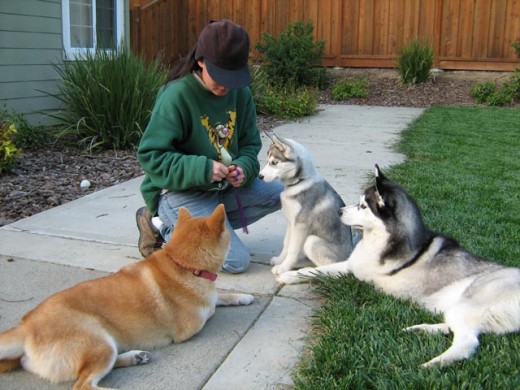
The stimulus must be weak enough, so that my dog is able to stay calm in its presence. Then, I get him to focus on me, by doing eye-contact commands or simple obedience exercises.
If my dog is able to focus and stay in-control, I reward him with a very high priority treat. For desensitization purposes, I usually bust out the really good stuff. I try to pick a highly aromatic or smelly treat that my dog loves, but does not usually get to eat. The smell will help to engage his nose, and further distract him from the source of his anxiety.
When he is comfortable with this exercise, is calm, and able to follow simple commands, I very slowly raise the strength of the problem stimulus. I make each session short, fun, and very rewarding.
In this way, my dog learns alternative behaviors for dealing with stressful situations. He also learns to associate something that was previously a source of fear and stress, with something positive (nice smells, yummy treats), and with being calm.

2. Calm Environment

Another important aspect of helping an anxious dog, is to create a calm and predictable environment for him, in his daily life.
- Fixed routine – I set a fixed schedule for feeding, walking, play-time, leaving the house, coming home, and more. I also establish a fixed set of rules, and a consistent way of enforcing them. A very fixed routine and rule-set, helps our dog understand what to expect from us, and also what we expect from him in return. Greater certainty reduces anxiety and stress.
- Staying calm – Most dogs are very good at picking up the energy of the people around them. My Shiba Inu, for example, is very sensitive to what I am feeling. If I get stressed and anxious, he picks up on that immediately and becomes anxious himself; but with a hundred times more gusto! Therefore, it is important for us to stay calm and in-control.
- Relaxing massage – Some trainers suggest giving our dog a massage to help him relax. There is also the special TTouch massage method, which uses circular finger motions to help relax our dog’s body.
I tried the TTouch method briefly on my Shiba Inu, but it did not seem to have much of an effect on him. Desensitization exercises, together with a fixed routine and consistent rules, helped us most.
3. Calming Equipment
There are a variety of products designed to help calm our dogs. The attraction of such products, is that they require little to no work from us. However, it is also unclear how effective they truly are.
a) Dog Appeasing Pheromone (DAP)
DAP is a synthetic chemical that was developed based on a hormone produced by nursing mother dogs. Mother dogs produce this hormone to help their puppies feel calm and secure. It also helps the mother dog establish a positive bond with her puppies.
Scientific studies *do* show that DAP has a positive effect on puppies. However, it is unclear whether DAP helps with anxiety problems in adult dogs.
There are also a variety of natural calming scents, including lavender, and other herbal remedies.

b) Dog Calming Music
“Music has charms to soothe a savage breast, To soften rocks, or bend a knotted oak.”
~~[William_Congreve]
Music can certainly help calm us down and soothe our nerves. Therefore, it is not such a big stretch to imagine that it can also be helpful to our dogs. However, the wrong kind of music can actually increase anxiety in dogs.
What is the right kind of dog music?
According to sound researcher Joshua Leeds,
“Rock music, jazz, heavy metal made them more anxious. Classical slowed them down. It just relaxed them in a way that the other music seemed to irritate them.”
~~[Want to Calm Fido Down? Try Music!]


The Thundershirt looks like a dog winter coat. It wraps around the torso of a dog, and works by exerting constant pressure on the dog’s body. Proponents argue that this pressure, can have a calming effect on the dog’s nervous system.
However, the only study I found was a very limited experiment, from an unsubstantiated source. Therefore, it is unclear whether the claims made on the effectiveness of Thundershirts are true.
Note – Pressure wraps will not work on all dogs. Some dogs may get even more anxious, when they experience continuous pressure on their body. In addition, it is unlikely that pressure wraps can fully solve our dog’s anxiety issues. Wraps and other calming equipment, are commonly used together with desensitization and other dog behavior modification techniques, to achieve true long-term success.
Depending on the dog and the situation, you may need to incorporate training with the cape to show an effect. The Anxiety Wrap recommends an 11-step treatment program for separation anxiety that includes using the wrap and leaving toys filled with favorite food treats for the dog to enjoy while you are gone.
Some people also use clocks or heartbeat pillows, to help calm new puppies.
4. Medication
Do not medicate your dog with over-the-counter human drugs, on your own. Dogs have very different physiology than humans, and dosage is very dependent on weight.
I always consult with my vet before giving my dog any medication.
Some medications used to suppress a dog’s anxiety response include –
- Clomipramine(Anafranil) – This drug was originally developed to treat OCD in humans. With dogs, it is sometimes prescribed to treat OCD and separation anxiety issues.
- Fluoxetine(Prozac,Sarafem,Fontex) – Fluoxetine is perhaps most well-known by its tradename Prozac. Prozac is used to treat heavy depression, OCD, and serious eating disorders (Bulimia nervosa) in humans. Eli Lily makes a special Prozac for dogs called Reconcile.
For lonely dogs with separation anxiety, Eli Lilly brought to market its own drug Reconcile last year. The only difference between it and Prozac is that Reconcile is chewable and tastes like beef.
- Sedatives – Powerful sedatives such as benzodiazepine (benzo) are prescription only. Some lighter sedatives such as antihistamines (Benadryl) and valerian can be obtained as over-the-counter medications for humans. Do not give sedatives or any other medication to dogs, without first consulting with a veterinarian.
The dog medication business is now a very profitable enterprise, and there are a large number of dog drugs available for purchase. These medications treat anything from separation anxiety, OCD, and depression, to motion-sickness, forgetfulness, and obesity. Most dog medications are short term solutions and may have serious side effects.

Dog Anxiety Problems
I believe that the best way to help our dogs with their anxiety issues, is through desensitization, as well as a calm and relaxed home environment.
Dog calming equipment and medication are very tempting solutions, because they involve little to no effort from us. However, their long-term effectiveness is highly questionable. These methods work by suppressing or muting the effects of anxiety, rather than addressing the source of the anxiety itself.
This is in contrast with desensitization and home management techniques, which target the anxiety stimulus, and teaches the dog new ways to cope with fear and stress. Rather than just suppressing symptoms, desensitization helps to build a dog’s confidence, and promotes a stronger bond between him and his human companions.
Ultimately, behavior modification and desensitization techniques lead to long-lasting effects, and a better quality of life for a dog and his family.
my dog a five year old is a cross jack russell and cocker spaniel she has always been a loving dog but recently she will just start barking and growl at things we cant hear she even barks and growls at me and my husband when we are just stood up doing something, when we get up to leave the room, even when we talk to each other when shes a sleep she will jump up and start barking, she has always barked when a jet goes over but we are okay with that cause we just usually cuddle her and say gone now i dont think she is in pain cause she is eating and drinking okay she loves going on her walks, and she is still playful but one thing i have noticed is she has started yawning more than usual a lot of this has accured during the fireworks and my smoke alarms has started mal functioning and keeps going off which we are waiting to be replaced but she always barks just before they go off we just tell her good girl i am really worried about her cause her behaviour has really changed just want my loving little girl back
I have been worrying about my dog’s state because he hasn’t eaten anything since yesterday, that’s why I’m currently looking for a veterinarian. I never knew that a dog experiences anxiety when he chews up furniture, walls, and shoes, surprisingly, he’s also doing this bizarre thing. I’m glad you shared this; I’ll keep in mind to massage him because according to your statement, this can help him relax.
Hi. I’m really hoping you can help me. We have a 10 year old wheaton, Jasmine. She has always hated dings and dongs. This noise anxiety is getting much worse. Lately, when we let her out in the back yard she won’t come back in. I mean through rain or snow. She prefers to be outside where there are no dings or dongs. When she does come in she goes to the basement where there are no people or sounds. This is very difficult as every time I get an email/text my phone dings or knocks. I’ve tried many different sounds but she doesn’t like any of them. My new stove timer is a ding. The house is surrounded with dings and dongs. I don’t see how we can get rid of all these sounds in the house….poor baby. What to do??
I’ve had my terrier for two years. He is a rescue and came to us at 1 year old. He had been living outside and was not house trained. The situation may have been puppy farm but i actually got him from the breeder, who told me he ” had to take him back because the man who he sold him to had got into trouble” I’ve got no idea what that means but my dog was in a state. Matted fur and very quiet. He was quite shut down at first but as time went on he displayed anxiety in the form of shaking when left. We began to notice that he was hard to manage on the lead, pulling hard and having a really ad reaction when he saw any other dog- screaming spinning barking and trying to escape to get to the dog. We began lots of different attempts to help. Loose leash training desensitisation and counter conditioning herbal relaxant etc. One year on we have made some progress but not a lot. We have a greyhound as a companion for him now, which had helped a lot in the house but not outside. He is very calm in the house most of the time, his problem is the sound smell and sight of other dogs – but only when he is in the leash- he can go into a secure play field with upto 10 other dogs and he shows no sign of aggression- just plays all day, however put him near a dog with a leash on, he will attack that dog. It’s something to do with the leash but also generalised anxiety is a problem. He will have phases where something will happen such as a family member goes on holiday, and he will refuse to eat, walk backwards everywhere and shake for upto 2 weeks in and off, then it will pass. He is terrified of s certain type of beep- so if it’s a device that beeps at a certain frequency- he will freeze and shake like he is fitting, and slaver. Makes me think that maybe someone has used a shock collar in his past. Routine and a calm house has helped the most. I’ve had minor success with dap collars and valerian but it’s limited.
The worst problem is his leash reaction, I know he does it because he’s scared but it does look like aggression. I can’t afford a trainer and my vet has mentioned Prozac but I don’t want to go there if I can help it. Despite these episodes that happen occasionally- he is happy when he’s in the house. He loves us dearly and we love him. Any advice would be great