What is a dominant dog?
Some people attribute all problem behaviors to “dominance“, while others do not want to use the “dominant dog” label at all. The truth, as always, is somewhere in-between.
It is useful to recognize dominant behaviors in our dog, so that we can better manage him, keep him safe, and set him up for success. Refusing to use the word dominance, or denying its existence in dogs, is unhelpful.
Any pack animal including humans and dogs, have to deal with dominance issues, because it is part of pack dynamics.
Similarly, trying to explain everything away by using the dominant dog label or excuse, is also unhelpful. To really fix a problem behavior, we want to fully understand it, and correctly identify its source. For example, a dog may show aggression because of dominance. However, dog aggression can also be the result of fear, stress, play, curiosity, boredom, or something else.
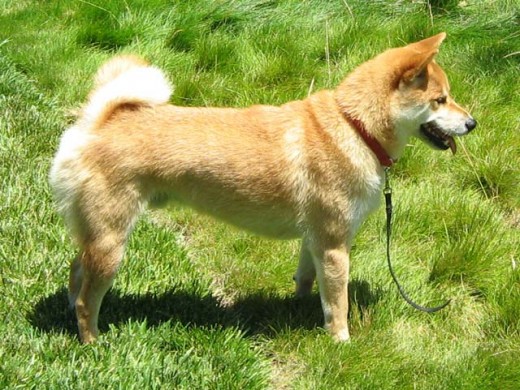
Dog Dominance
Dominance is a fluid concept.

Dogs are not dominant all of the time.
For example, many dogs will show greater dominance when they are on home turf, or when their owners are around. Under different circumstances, these same dogs may become less assertive, or may even become submissive.
Observe our dog carefully, and identify when he is more likely to show dominance, and why.

Dominance is a relative concept.
My Shiba Inu, for example, is more dominant than most dogs I have owned. He challenges me more frequently, and is constantly testing his boundaries. He has a dominant body posture, and he will not back down when challenged by other dogs.
My Siberian Husky, is a more submissive dog. She usually stops whatever she is doing, when I tell her to. She very quickly backs down, and uses submissive body language, when confronted by other dogs.
However, this does not mean that my Husky will always back down, or never show any dominance behavior. She simply prefers to avoid conflict, and has learned that she usually gets more, by seeking a peaceful resolution. I make sure to encourage this behavior, by rewarding calmness and conflict avoidance very well.
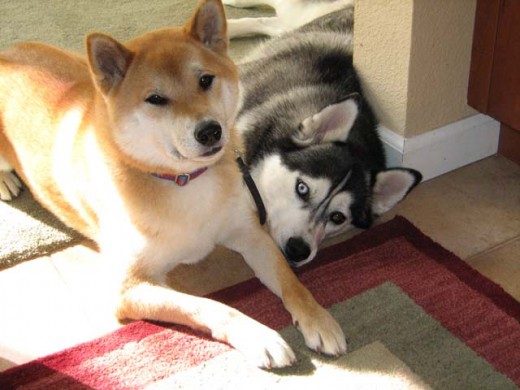
What is a Dominant Dog?


- A dominant dog will likely respond with aggression when he is frustrated, or when he feels threatened. He may also redirect that aggression onto us, if we try to physically engage him.
- A dominant dog is more forceful when it comes to fulfilling his own needs and goals. He is not afraid to challenge those around him, and to continually test his boundaries. My Shiba Inu is always testing to see if particular rules, such as the no getting on furniture rule, still hold true.
- A dominant dog is more likely to fight, and less likely to submit or run away. My Shiba Inu likes playing with other dogs, but he generally does not get along with dogs who try to dominate him. If challenged, he will not back down, and this can result in a dog fight.

Dealing with a Dominant Dog

1. Calm and decisive pack leader
Being angry and shouting at our dog, will only worsen his behavior. Fear and uncertainty will increase his level of stress, and cause him to behave in a more erratic fashion.
The best way to deal with a dominant dog is to remain calm, and firmly remove him from the environment or object, that is causing him to act out.
2. Avoid physical corrections
Contrary to common belief, physical force or physical corrections is NOT a good way to deal with dominant dogs. If not perfectly executed (with perfect timing, force, and technique), a physical correction may further frustrate our dog, and cause him to get more aggressive.
Instead, stay calm, keep physical interactions to a minimum, and quickly leave the stressful situation. In addition, using physical force against a dog, may end up teaching him the wrong lesson; in particular, use violence against violence.
True alpha dogs lead by controlling the pack’s resources. We can control our dog’s resources by following the NILIF (Nothing in Life is Free) program, and using reward obedience training.
3. Management and supervision
We want to step in and stop any aggressive behaviors, before our dog escalates and loses control. Prevention is key when dealing with a dominant dog. It stops him from practicing aggressive behaviors, and it enforces the important lesson that we are calm and in charge.


4. Consistent rules
To become a good pack leader, it is important to develop a set of house rules and some structure, for our dog to follow. Always be consistent with enforcing all of those rules.
My Shiba Inu’s most important house rules include –
- No getting on furniture,
- No biting on people,
- No leash biting, and
- No food aggression or resource guarding.
5. Frequent obedience training sessions
Schedule at least two or more short (10 – 15 minutes) obedience training sessions with our dog, every day. It is a good idea to keep up with obedience exercises, throughout a dog’s life. This keeps him mentally sharp, and makes it clear that we are in charge.
6. Use proper equipment to control our dog
When dealing with aggression, safety should always be a primary concern.
Use whatever equipment is necessary, to keep all the people around our dominant dog safe. A drag lead may also be useful because it gives us good control of our dog, without having to lay hands on him or his collar, and without resorting to chasing games.
If our dog has a bite history, it may be necessary to use a muzzle. I like the basket muzzle because it does not overly constrain a dog’s mouth, and is more comfortable. A basket muzzle will still allow a dog to eat and pant.
Be careful not to aggravate our dog’s aggressive behavior by overly constraining him, and causing barrier frustration. When in doubt, consult a professional trainer.
7. Set our dog up for success
Try to minimize the number of dominant displays. Identify objects (e.g. other dogs, cats) and environmental conditions (e.g. loud noise) that trigger dominant behaviors, and avoid those triggers.
Then, gradually desensitize our dog to those events, in a controlled fashion.
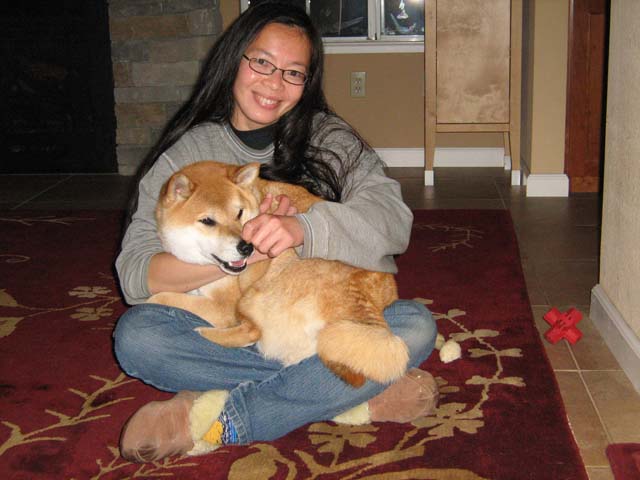
Many dog behavioral issues, including resource guarding, biting people, dog-to-dog aggression, sensitivity to handling, growling at humans, and general disobedience, are often attributed to “the dominant dog”.
However, each of these problems are unique, and complex. They are usually the result of many factors, one of which may be dominance. In fact, many behavioral issues are the result of stress and fear, and have nothing whatsoever to do with dominance.
When dealing with dog behavioral issues, it is best to keep an open mind.
Observe our dog and his environment carefully. Identify the triggers for his aggressive behavior, and try to understand why he is responding in this way. If his aggression is extreme (e.g. he is breaking skin, and/or causing puncture wounds), hire a professional trainer to help us carefully trouble-shoot the problems.
Yea yea I need help with my blue Healer
Hello: In reading your column, I find it practical and no-nonsense. Most other columns are preachy but unhelpful. Thank you for that.
To my issue, then. I have a 3 yr old Alaskan Husky which I raised from a puppy.. He has been off leash since 4 months and is reasonably obedient when called to heel. Also he has been socialized since 3 months.
He is sweet and very affectionate with people, even children. He has become more sedate and relaxed in the last 8 months in terms of his behaviour around people and the cat.
He is excellently behaved when in the house and well behaved in the yard.
However, he used to be very playful with other dogs, yet recently he has become more aggressive and hostile towards any dog he does not already know.
There are some issues with this:
1- Some instances are clearly dominance behaviour and there is little concern, except that many dog owners are clueless regarding dog behaviour. Also many of them do not understand the concept of off-leash park. But that is a people issue, as you say.
2- Some instances are more clearly aggression and gets rough with dogs of any size. This
This happens on leash or off leash. He does stop and wait for me when he sees another dog before going forward, which often gives me time to assess the situation and decide whether a leash is the appropriate action, such as the other dog being significantly smaller or a puppy.
He is not neutered, but I am not sure that has much to do with it, as some of his friends are not neutered or spayed.
This has led me to rearrange the times at which I go to the leash-free park, which may be counterproductive as he will socialize less.
Any suggestions?
Feeling frustrated and disappointed! I have a 11 year old spayed female beagle mix Dixie, wouldn’t hurt a fly and a 10 month old queensland heeler Sierra who is still intact, has had her first heat and will be spaying soon. Dixie has hated Sierra since we brought her home at 7 weeks old. Now that Sierra is bigger she is having dominance aggression towards dixie and it’s unpredictable and she just attacks out of no where. I’m thinking she is jealous and seems to happen with me and not my husband. I’m Sierras person more than my husband. Sierras a good dog except for this one thing. I have to keep them separated and the moment I let my guard down she attacks Dixie. I cannot have her continuously attacking Dixie she’s 11 years old , she’s older and she is a very innocent dog and not fair for her to be attack out of nowhere. Sierra does get favored and we give her a lot of attention due to the fact of her being a puppy she spoiled. I’ve done all Sierra’s training myself your basic sit stay leave it etc. a trainer around my area is quite expensive looking for ways to be able to handle this myself so Dixie does not get hurt and I can nip this in the butt and hoping that spaying will help Sierra is getting exercise we go to the beach every weekend. The only interaction with other dogs is at the beach if you have any suggestions that would be wonderful! Thank you
Hey! My name is Leonardo, but you can just call me Leo. I have a Gerberian Shepsky, at home who is around 8 months now. Her name is Cinno (pronounced as “Cheeno”) and i’m having a few issues with her. Although she is extremely friendly and playful and quite smart she is very disobedient. she will run out of our estate when she gets the chance to.
She become very aggressive and bite, hide and run from you when you try and take something from her that could even potentially hurt her. she bites when she plays with you and although it wasn’t a big deal when she was smaller and younger it is now, that she’s growing. she stopped biting the furniture but unfortunately after she destroyed it.
She only obeys commands when she sees you have food in your mouth. Right now, i’m working on getting her to return back to me after running away. If she learns that, it’ll be a big help.
Could you advice me on anything else i could do to help train my dog? I know she’s a puppy right now and i want to get going with these techniques as soon as possible so when she grows up it’ll be easier for me and most importantly, her. Thank you so much in advance!
I have a Staffordshire bull terrier, I’ve had her for 6 years and up until 3 years ago I’d never had a problem with her, I could let her off her lead down the park and never have to worry. Since meeting my partner who had a young staffy (now 4), my Bella goes for any dog if we are out walking. I’m abit lost for what to do.. i think she’s being protective over our other dog but I don’t know how to stop this, she never bites she runs and head buts these other dogs while making an absolute racket but it looks very aggressive.
Hi we just adopted a very large male american bulldog mix. Hes very pushy and likes to bark. He pulls on lead everywhere and today put his kouth on me and growled when trying to get him out of the trash. He stands over my other dog and barks. Im trying to be cautious bc i have three kids, one is a toddler. We have been making him sit before food and treats and before going out or in the house. He has had no training and i want to keep my kids and him safe. Any tips?
I m having a very serious issue..We have a female rottie, a female pit bull they got along just fine. Sometimes a little pissing match but nothing vicious..We recently got a male puppy..Well now its game on! Both the female rottie and the female pittie are at each other for blood fighting..they cant even see each other without a dog fight. I mean a fight for blood each gets along fine with the new male pup. My rottie more so because they are both young. We had our female rottie fixed thinking that might help the issue. The female pittie is being fixed in 2 weeks. We are at the end of or ropes keeping the house divided and making sure doors are closed and they dont see each other. Please what can we do? desperate for help.