Set up a schedule and carefully supervise our puppy.
The little puppy is very curious and will get into trouble every chance he gets.
To save ourselves a lot of pain and to save our puppy from stress, we want set up a fixed schedule which includes crate time, play time, walk time, as well as handling and grooming time.

When our puppy is out and about in a non-dog-proof area, we need to supervise him closely. Close supervision will give us the opportunity to teach puppy right from wrong, without too much damage to our furniture and belongings.

If I do not have the time,
- I usually crate puppy, when he is home alone, or
- I put puppy on a tie-down, when I am home but unable to fully supervise.
If you are concerned about crating your puppy, here is what the Humane Society of the United States and the American Dog Trainer’s Network have to say about dogs and crates.
When I am away for a long period of time (> 3 hours), I put puppy in a long-term enclosure. This can be a secure puppy pen or a safe room (e.g. kitchen). I make sure there is nothing in the enclosure that my puppy can destroy. I also put in some bedding, a water bowl, puppy pads, and safe chew toys.
As a general rule, the longest time to crate a puppy is (age of dog in months) hours. For example, an 8 week old puppy can be kept a maximum of (2 month old) = 2 hours in a crate. Note that this is just a general guideline for the maximum crate time.
Most puppies need to go outside more frequently than that, for exercise and potty training. I take my puppy outside as soon as he wakes up, and right after any kind of vigorous play. In the beginning, Husky puppy Shania needed to potty after about 10-15 minutes of play. Here is a more detailed table of maximum crate time.
At night, I crate my dogs in the bedroom. Sleeping together helps with the bonding process, and shows them that they are part of the pack.

2. Keep a drag-lead on our puppy

I put a drag-lead on my puppy when he is roaming freely in the house.
This will help us control our ball of energy without resorting to chasing games. When my puppy tries to run away, all I need to do is step on the drag-lead.
I use a regular, thick (1 inch wide), flat collar or harness and not an aversive collar (choke chain, prong collar). I make sure to cut off the loop on the leash, so that it does not catch on anything around the house. I start with a longer (6 feet), light leash, and then shorten it depending on my puppy’s behavior. I only do this while I am around to properly supervise my puppy.
Once he matures and is better behaved, I switch to a leash tab or remove the drag-lead altogether.
It is best to use a secure 6 foot leash during puppy leash training and not the flexi-leash. The 6 foot leash gives us better control of our puppy, and is necessary to keep him safe when he decides to go chasing after dogs, cats, or squirrels.
3. Start with reward obedience training


It is most effective and least risky to start our puppy with reward obedience training. I started out with aversive techniques, and it made my Shiba puppy develop additional behavioral issues, including aggression. In fact, my aversive based dog trainer said that it was inappropriate use pain based techniques, such as leash jerks and alpha rolls, on dogs that are younger than 6 months old.
Today, I prefer to use reward training because it is more effective at motivating my dogs, stopping undesirable behaviors, and building a strong bond.
With reward training, we establish ourselves as the pack leader by controlling our dog’s resources through the Nothing in Life is Free (NILIF) program. This simply means that my puppy has to do something for me, for example a Sit, before he gets any resource (e.g. food, toys, affection, freedom) in return. Any bullying will be ignored, or will result in the removal of that resource.
Many people make the mistake of equating pack leadership with the use of aversive training. Aversive dog trainers say that difficult, strong-willed, dominant dogs require stronger, punishment based methods in order to show him who is boss.
This is not true.
One of my dogs (a Shiba Inu) is extremely strong willed, and can be quite difficult, but he responds much better to reward training.
Be careful of advertisements for 10 minute puppy obedience training programs and the like. There are no miracle cures in puppy training.
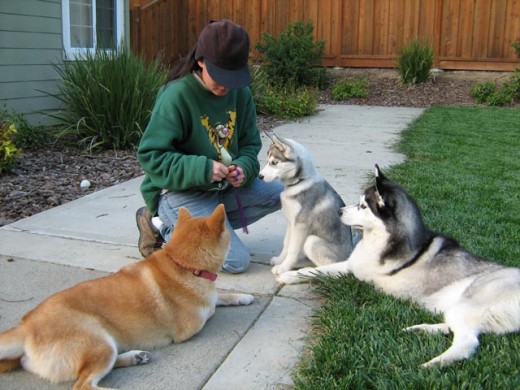
4. Bite inhibition training
Puppy biting is common because puppies are naturally curious, and want to examine everything with their mouths.
The good news is puppies do not have the jaw strength of an adult dog, and will not do much damage to us when biting. Because of this, puppy-hood is a good time for bite inhibition, or soft mouth training.
One of the best ways to train a dog to have a soft mouth is through hand-feeding.
I hand-feed my puppy at least some of his kibble every day. If he bites too hard when getting his food, I do a sharp ouch or yelp and ignore him for a few seconds. Then, I retry the exercise. If he takes food from me gently, I praise him and continue feeding without any breaks.
We can also combine hand-feeding with obedience commands, and dog grooming sessions. Hand-feeding also helps with food aggression issues, so I continue with it even through adulthood.
Ian Dunbar’s book After You Get Your Puppy, gives a good overview of bite inhibition, and how to best train our puppy to have a soft mouth.
A puppy, and ultimately an adult dog who has a soft mouth is a great asset. Because my Shiba Inu has good bite inhibition, we were able to solve many of his behavior problems, which would have been difficult to deal with if he were biting at full strength.
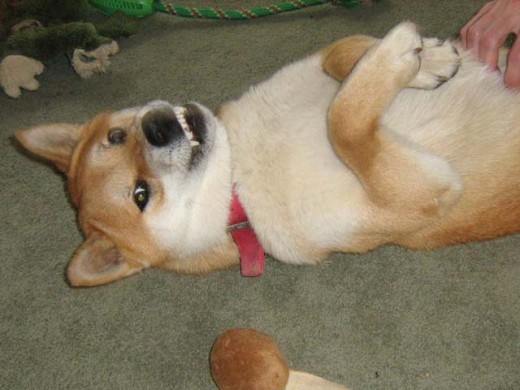
5. Practice calm and assertive energy
This is something that is always emphasized by Cesar Millan (the Dog Whisperer) and it is extremely important; especially for a hyperactive puppy.
If we interact with a dog using nervous, submissive, fearful, or otherwise weak (non-assertive) energy, the dog will sense that and start acting out even more.
Anger, impatience, frustration, and all other non-calm energies will only excite our puppy, and cause him to exhibit even more extreme behaviors.
In order to achieve calm, assertive energy, we must first overcome whatever fears we may feel toward our dog, and become his pack leader. This is much easier to do if we have achieved good bite inhibition.
6. A busy puppy is a good puppy

Puppies have a lot of energy, and will get into trouble if we do not keep them busy.
I make my puppy work for ALL of his food. Instead of presenting everything to him in a silver bowl, I use his daily kibble and treats for obedience sessions, bite inhibition training, handling, and grooming. If there is food left over, I put it in interactive food toys.
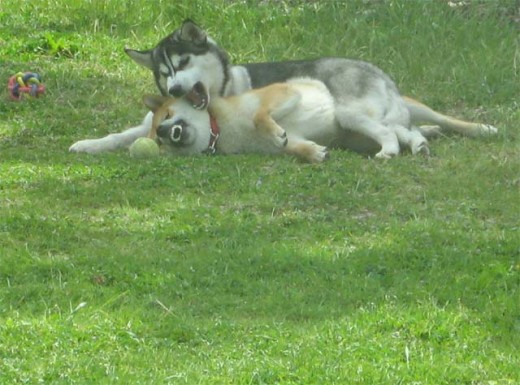
I also schedule play time with my puppy. Some games that my dogs like include flirt pole, the water hose game, and sometimes soccer.
When I start with a new game, I make it fun by handing out lots of treats for effort. Once my puppy understands the game, I switch to only treating his more stellar performances.
Make sure to always have control of a puppy’s play-time. This means that we own all the toys, and we decide when to start and stop the games. Play-time can be very useful in training our puppy to calm down, and to pay attention to us even when he is excited.
I also schedule two or three short obedience training sessions (10-15 minutes) with my puppy every day. This helps to establish me as the leader, gives my puppy some mental exercise, and provides a good bonding experience.
Other good ways to exercise our puppy (after full vaccination) include neighborhood walks, walks in the park, dog playgroups, and dog sports.

7. We are not alone
The most important thing to remember while bringing up a difficult puppy is that we are not alone!
Our puppy journey will be filled with a lot of joy, but there will also be challenges and pit-falls. Sometimes, we may feel discouraged by our puppy’s behavior, or with his performance in dog obedience class.
We are not alone!
There are many support groups out there where we may post our questions. I also find it helpful to visit these groups when I feel discouraged, or when I feel like my puppy is some mutant strain of devil dog.
Do not think that you are a bad dog owner or trainer when your puppy behaves badly. Many other dog owners are facing the exact same problems. Also remember that with proper rules and training, our puppy’s behavior will improve with time.
How to take care of a puppy at night?
My wife recently thought of getting a new pet dog to give our kids some company and to help teach them some care lessons along the way and I want to know what are the best start care tips for a puppy. I loved your explanation of obedience training and how it can help the puppy develop proper house behaviors in the long run because my kids are young and so if they develop a good bond with a dog as the dog grows up along with them, they can learn the real value of responsible dog ownership while being safe from aggressive dog tendencies. I’ll be sure to show my family this article before we look for any puppy breeders. Thank you!
Dear New Friend,
I have decided to help out and rescue a dog from homelessness (it may be temporary but I hope not). He is 2 years old and MASSIVE. He acts like a puppy, in that he wants love all the time and has been so good about not chewing or being bad in the yard. He shows potential to be trained and learns quite fast. He is already playing soccer and fetching. He has also learned to drop the ball and back off (so now I can pick it up without being afraid he will dive in for my hand). His jaws are massive so keep that in mind while you read the rest because I think that is my biggest fear. I know in another article you mentioned you had to adjust your fear because your Shiba would at most cause puncture wounds, but I am pretty sure this dog could dislocate and maul my hand. Augh so scary. But regardless, within 2 days he has started trusting me, even enough to take a shower in a closed walk-in shower (he was full of fleas but was a trooper who allowed me to clean him as much as possible without giving me a hard time). He puts his heads between my legs when he is uncomfortable so I have learned to take that as a sign to slow down. He is bigger than any dog I remember having as a kid. I was told I had bigger dogs but I wasn’t in control of training them. So naturally, I am terrified. I have another dog in the house who has been with us for 7 years. She is a rescue and honestly an angel. We got so lucky with her as she shows all the positive traits of a JRT but is extremely mellow and independent (in a good way, not annoying at all and sometimes we even forget where she is in a room because she is so quietly sitting in her bed). I am terrified of letting the two get close to each other because I have nightmares that the big one will crush my JRT or catch hold of her in his mouth. I do not know what I will do in that situation and it may be the reason I have to take the dog to the pound. I don’t want to do that and I want to be strong. The new dog accepts me as alpha. He listens but sometimes he will wander off to test his limits and then come back. I think a leash with a lead on it will be really helpful here so I am going to try that. He has a tendency to open his mouth and try to rest his teeth on different surfaces but I am trying to adjust that. I was thinking that if I started with objects that I didn’t want him to bite and use keywords, he won’t show aggression towards my other dog. He has barked twice at her but both times his tail was wagging and when she is on the other side of the glass door, he whines. I don’t want to mistake this as him wanting to play and then we have a terrible experience. I was wondering when are usually times that you justify using time-out for him. I could send him out to the patio but I don’t want him to think he is able to go outside and get the wrong idea. I’d rather it be a very boring room in my house with no interaction. He is getting attached to me so I would like to keep him and train him, but I am not used to a dog of this size. Any tips or resources? He really does act like a child and I do want to try. I hope that counts for something. I am heart broken as to how his previous owners left him in the back yard for days without food or even a blanket. Is it possible to train a dog like this? This big? He is a Blue Heller mixed with JRT I believe or a Boingle?
Hey,
we have 6mo groenendael (belgian shepherd), for now we’r doing basic obedience… Lately he started attacking leash, like playing thug-o-war with leash, and he’s only doing these on walks with me, when hi’s with bf everything is ok. He’s obedient till one cklick, and than he starts attacking, and nothing helps (i tried ignoring him, food luring..) the only way we could walk home is when i lure him with a toy till home. So i start thinking if it’s maybe dominance towards me? What do you think it’s the best way to cope with that behaviour? Thank you!
The articles are very interesting and helpful. I have a 5-month old Shiba Inu, which is behaving really good, but we have one problem:
I would like to let him run around without a leash, when we are outside in the park, so that he can play with other dogs. The problem is, that he isn´t coming back and even with some tricks you can not catch him.
He doesn´t really care if I am walking away or if I offer him some treats
I know that it´s difficult to train a Shiba Inu, but does anyone have a trick, how to train the dog to come back?
I would really appreciate, if you have a few tips for me.
According to my puppy kindergarten teacher, this should be able to be resolved by emergency recall. You will have to come up with a code word for this that you don’t normally use such as “Lucky” or something like that. You grab a hand full of really good treats and you make the dog follow you while scurrying back with the food in front of their nose while repeatedly saying the code word. After a few steps, you will need to grab their collar and spread the treats all over the floor and let him eat it. Do this only 1 time a day while training it and don’t use it for anything other than emergency situations. Hope this helps!