Operant conditioning does not mean reward training.
Operant conditioning actually encapsulates both reward and aversive training. In its simplest form, operant conditioning says that to modify a dog’s behavior, we can either add or take away a reward stimulus (positive reinforcement, negative punishment); or we can add or take away an aversive stimulus (positive punishment, negative reinforcement).

Operant conditioning in itself is not pro-reward stimulus or aversive stimulus.
However, it is interesting to note that B.F. Skinner, who developed many of the operant conditioning principles, has expressed that reward stimulus is the preferable form of control.
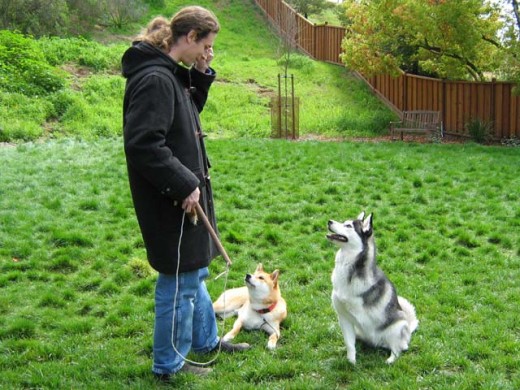
Operant Conditioning Trainer
When someone says “operant conditioning” trainer, it actually refers to all dog trainers because every trainer uses some form of operant conditioning techniques to modify a dog’s behavior.
Cesar Millan (The Dog Whisperer) uses operant conditioning techniques, Victoria Stilwell uses operant conditioning techniques, Brad Pattison uses operant conditioning techniques, and so does other television and non-television dog trainers.
Included in the operant conditioning framework are studies on timing, frequency, and schedules of reinforcement.
For example, operant conditioning studies tell us that a variable schedule of reinforcement is more effective than a fixed schedule of reinforcement. I.e. rewarding our dogs intermittently for behaviors is more effective than rewarding our dogs every time, or every other time.
Similarly, if you over-correct a dog, he will quickly get habituated to your corrections, and may no longer respond to future corrections.
Operant conditioning is based on many years of study, by scientists and psychologists.
It provides us with a useful framework to not only modify or shape the behavior of dogs, but also that of all animals.
When someone says that reward training does not work, or that aversive training does not work, it goes against all the scientific evidence that we have.

Modify Animal Behavior
Both reward and aversive techniques can be used to modify animal behavior.
This includes getting your dog to perform good behaviors (e.g. Sit, Down) as well as stopping your dog from performing bad behaviors (dog rehabilitation).
Personally, I use reward techniques almost exclusively with my own dogs because it is less risky, and the effects of making training mistakes are less serious.
When looking for a dog trainer, make sure to find one that understands the basic principles of operant conditioning and classical conditioning.
These two processes underlie much of what goes into dog training, and someone who understands these behavioral psychology principles will be in a better position to understand, guide, and shape your dog’s behavior.

Hi,
I am deciding wether to adopt an adult Shiba inu. I have been told that they may have some anxiety problems and that, in this case, it should be wiser to adopt a puppy in terms of educating it. I habe also heard that it is more difficult to create a strong bond if the animal is already a few years old. Plus that it will be completely impossible to teach them to walk freely/without a line amd that they will pretty much never listen to you. Nonetheless, I would always prefer to adopt an animal rather than to buy it, therefore I am still more convinced about an adult animal, although I am not sure if it is really possible to handle every one of these issues.
I would very much like to know your point of view in this matter.
Thank you!
Best wishes, Sara
Hello Sara,
For me, the most important thing is getting a dog that will fit well with the lifestyle, temperament, and schedule of the entire family (including existing dogs). For example, there was this purebred Chow at our local SPCA that I totally fell in love with. However, Sephy (our first dog) was too high energy for him. The Chow (called Zen) was very well behaved, but he wasn’t happy with Sephy’s crazy antics. Later, he got adopted as an only dog by a young couple, so that worked out much better for him than what we could have provided.
When I was looking for a second dog, I started with nearby rescues. However, Shiba Sephy is very picky when it comes to housemates, so we ultimately decided on getting a puppy. Of course, it also depends on time range and other constraints (e.g. breed constraints). Each case, each dog, and each situation will be different. Personally, I would start with a rescue/SPCA, meet a bunch of dogs, and see how that goes.
Hi. I am desensitizing/counter conditioning my newly adopted 5 y/o Cavalier King Charles. He has poor manners and does not know how to approach dogs politely. When held back, he barks like crazy. I’ve been doing rehab for maybe 2 weeks now, and I do get frustrated/discouraged at times as we have to be really, really far away to keep him below threshold. Just wondering how long I’ll have to do this?????
HI! I would like to know how to quote you
Thanks
One of the most objective reviews I have read regarding aversive and reward-based training. Thank you for sharing.
Great Work. This has sparked many good points
I am currently studying Bsc Psychology and usually disagree with anything that claims it is using scientific principles as theories are usually used extremely out of context but this article is very good, it has all the basic key points without a scientific overload and uses the theories in the way they were intended! Thank you for a fab article!
Thank you Mia.
I have always found psychology to be a fascinating subject. Now I realize that it is not only fascinating, but also extremely useful. Psychology is one of the few subjects in college that can be applied over and over again in many aspects of everyday life. Wish I had taken more classes in college.
Good luck with your studies!
very excellent content