Dog psychology tries to understand bad dog behavior from a canine perspective rather than from a human perspective.
Because dogs are such close companions to us, it is easy to humanize them. Many dog movies and television shows including Lassie, 101 Dalmatians, Lady and the Tramp, Bolt, and others have encouraged this view.
However, dogs are not humans, and humans are not dogs.
Humanizing a dog causes miscommunication between human and canine, which can result in a variety of dog behavioral issues.
For example, many dog owners attribute their dog pooping on their favorite carpet or eating poop, when they are not home, as an act of vengeance. In actuality, it is just a symptom of stress from having an unexpected change in their routine (separation anxiety).

Dog Psychology vs. Dog Training
Some trainers claim that dog psychology involves pack theory and acting like a dog. According to them, obedience training is not dog psychology but simply teaching a dog tricks.
In particular, a dog who has undergone obedience training may understand training commands such as Sit, Down, and Heel, but may still engage in destructive and aggressive behaviors, such as chewing our designer shoes, or digging up our prize roses.
Is this true?
- Is there a big difference between dog psychology and dog obedience training?
- What about dog behavior modification?
- How do dogs really learn?
In fact, this separation of terms is unnecessary and only creates confusion.
Dog behavior modification, dog training, and dog tricks are ALL based on operant conditioning.


Operant conditioning forms a big part of what we understand of dog psychology and animal psychology. Therefore, dog behavior modification, dog training, and dog tricks are ALL based on dog psychology.
Based on these dog psychology principles, we know that dogs learn by repeating behaviors with good results, and stopping behaviors with bad results.
Operant conditioning consists of aversive methods and reward methods. Both aversive and reward methods, can be used to modify dog behavior, train a dog to follow commands, and teach a dog new tricks.
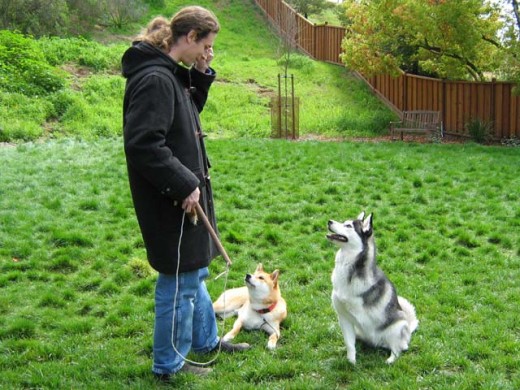
Misunderstanding of Dog Psychology

- The claim that dog obedience training, and dog tricks are somehow not based on dog psychology is false.
- The claim that food only works for obedience training and dog tricks is false.
- The claim that using food in dog training is bribery, and somehow ineffective is false.
- The claim that using food is humanizing the dog and therefore inappropriate is false.
- The claim that reward dog training is only based on food is false.
- The claim that aversive dog training, particularly physical force training is more effective at behavior modification than reward training is false.
- The claim that physical force is required to modify dog behavior is false.
- The claim that physical force is an integral part of dog psychology is false.
Both aversive and reward techniques, can be used to “train” our dog to sit on command, to sit instead of dig on command, to drop whatever he is chewing, to chew his toy instead of our shoes, and to dig in the sand pit instead of in the rose-bed.
The divide between dog psychology, dog behavior modification, and dog training simply does not exist.
Many of these supposed behavior modification techniques, including leash jerks, alpha rolls, and finger pokes, are aversive conditioning techniques.
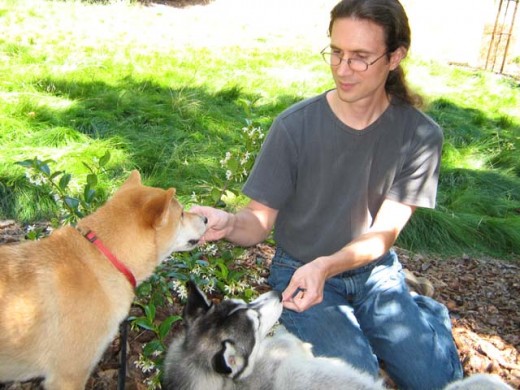
Dog Psychology and Dominance/Pack Theory
Dominance theory is based on the observation that wolf packs and wild dog packs are ruled by an alpha male and an alpha female. This alpha pair controls all of the pack’s resources and sets all of the pack rules. There are also rituals that pack members must follow including letting the alpha pair have access to the best food,best sleeping area, and best resources.
The theory is that when dogs come to live with us, we become part of their pack and must assume the alpha male and alpha female positions. Part of assuming this position, is to follow similar pack rituals including eating before our followers, not letting our followers have access to beds and couches, always walking in front of our followers, and using physical force to establish and maintain our pack leadership position.
However, recent studies have shown that wolf packs and also wild dog packs are a lot more complex than this simple alpha-pair model. Leadership tends to be more dynamic in nature, and the alpha dogs rule through the control of resources rather than through physical force.
Therefore, even dominance theory cannot be used to support the false claim that physical force is a necessary, or even an effective part of dog behavior modification.

While dominance theory and dog pack dynamics are interesting areas of study, the argument of whether they apply to us and our domesticated dogs, is actually a moot point.
Just as dogs are not humans, humans are not dogs.
Contrary to common belief, dogs know that they are dogs and not human. They also know that we are human and not dogs. It is us humans who frequently get confused on these matters.
Since we are human, we are not expected by our dogs to act like dogs. We must communicate with them in a way that they can understand, but that does not mean that we should try to act like them. Not only would we be poor imitators, but however well we pretend, we would still be human, and our dogs will always know what we are.
Because our dogs live in our very complex human world, it is necessary for us to assume leadership and teach them our rules. We must provide for them not just in terms of food and shelter, but also in terms of their health and safety.
To properly manage the safety of a dog (to himself, to other dogs, and to the people around him) it is necessary to institute certain human rules, and to train him to follow those rules. Training of these rules can be achieved through aversive methods or reward methods.
It is as simple as that. No dominance theory required.

Dog Behaviorist vs. Dog Trainer
By using operant conditioning techniques, we can shape behavior to prepare our dog for obedience trials, or agility competitions. We can also modify behavior to make our dog into a good citizen at home.
A good dog trainer or dog behaviorist is someone who –
- Understands classical and operant conditioning theories,
- Has good technique (i.e. good timing, execution, redirection);
- Can quickly and accurately read a dog’s body language; and
- Is a good and patient teacher.
There are dog trainers, like Cesar Millan, who mostly use aversive training. There are dog trainers, like Victoria Stillwell, who mostly use reward training. And there are dog trainers who use both.
Reward dog training and aversive dog training have their own advantages and disadvantages, so make sure to pick a dog trainer that uses the style of training or behavior modification that you feel is most appropriate for you and your dog.
The Association of Pet Dog Trainers is a great resource for finding professional dog training help in your area.

Which is Better, Which is Right, and Which is Dog Psychology?
Many arguments arise in the dog behavior modification or dog training arena because many want to claim that their way is better or that their way is right.
To do this, they must first differentiate their way from all other ways. That is why there are so many terms, including dog psychology, dog behavior modification, dog training, dog tricks, and many more, describing essentially the same thing.
Moral judgements such as dog cruelty, dog bribery, evilness and goodness get thrown into the same pot and what results is a whole lot of smoke and not much else.
When we boil dog training or dog behavior modification down to its basics, we are always left with conditioning. And all of us use either aversive operant conditioning methods or reward operant conditioning methods to shape our dog’s behavior.
Both are dog psychology. Both have their own advantages and disadvantages.
I cannot say that one is absolutely better than the other, or that one is absolutely right. I can only say that I personally use reward dog training because it is more effective and less risky than the aversive methods I have tried.

One thing I have learned, especially in this age of speak first and think later along with our ignorant and inane political tantrums and arguments is that there are a helluva lot more dogs I want to spend time with than there are humans!
Thank you. Positives such as affection and food and such are very effective. But using nudging and tapping for negative behaviors also work as they are a stark and unwanted outcome. This yin yang approach has worked very well on our dog.
I do like that you provide accurate information and link it to some studies.
Then you write,” I cannot say that one is absolutely better than the other, or that one is absolutely right. I can only say that I, personally, use reward dog training because it is more effective and less risky than the aversive methods I have tried”.
That goes against the studies and the information in the rest of the blog. Stick up for science. If you find positive reinforcement more effective than aversive training, then why not state that? When the studies that are linked to your accurate information say the same thing, why not state it? Today, every study done on domesticated dogs consistently shows positive reinforcement without negative reinforcement or positive punishment, is more effective and has no detrimental long-term effects. So, I’m going to agree with your dismissal of what you wrote. Yes, one method is absolutely better than the other method, which you overwhelmingly support in your blog, when you write that one is an absolutely right or more effective the rest of your information becomes less effective. Scientifically, overwhelmingly aversive training has is less effective and prohibitively risky to a dog’s well-being.
Of course, you can conclusively say one is better than the other, if you read the study of anything it’ll have a conclusion. When you add that paragraph, it reads as if you’re concerned about somebody taking offense or being defensive about dismissing dominance theory. The whole point of scientific study is to remove the emotions and anecdotal information that gets mistaken for facts. Science isn’t polite or concerned with making people feel better about being wrong.
The only reason I’m driving this point so hard is because accurate information shouldn’t get diluted into opinion, and opinion should not be undiluted into science.
I believe that right or wrong is a subjective concept. As such there is no absolute right or wrong. Science does not prove absolute right or wrong. It provides various experimentally-based perspectives on a given situation. It is up to each person to decide for themselves what is right or wrong given the information they are willing to absorb, how they interpret it, what their priorities are, etc.
In my opinion, everybody is trying to do the “right” thing, but there are many paths and it may not be clear which one is “right” for them. I try to present the information and provide my own perspective on what I do and why. This more recent article has a bit more of my thinking on the matter – https://shibashake.com/dog/emotional-awareness-and-mindful-dog-training/
Thank you for asking this thought provoking question and sharing your interesting perspective. It has been quite helpful for me.
Few months earlier I saw an injured street dog in my locality.. So I started to give medical treatment by myself and now she is totally fit and fine.. In the month of August she gave birth to 6 puppies out of which only 2 survived. As I only feed the puppies and the mother because of which they most of the time remain outside my home.
I thought of putting the puppies up for adoption as the age is now 2.5 months so that they don’t have to roam on streets and am already in process of sterilization of the mother dog. As a result I got a lead for adopting both the puppies..and they finally have a forever home now.
All I am right now worried about is did I make a right choice by giving a 2.5 month old puppies because it separated them from their mother.. All I can think now is that was it a good decision of separating the puppies from the mother at 2.5 months of age though they are safe with the person who have adopted them.
It seems as if now the mother is in search of the puppies and keeps finding them and roams in the street here and there. Though she does eats food and drinks milk as I feed her and wags her tail as well. I am not very sure if she searches for them and if she is sad by not seeing them.
If you could help me that did I make a right choice or should I bring back the puppies to the mother.. I would really be thankful to you and would further help me to know more about dogs
Hello, I am a student working on a project where I am researching about dog psychology. Is there any way, I could contact the author of the website thorough an email, to get more information. Please drop any of your contact details preferably email in the reply.
I have a 5yr old Kelpie who appears to have an invisible friend in our car in the corner behind the driver’s seat. When first getting into the car she will go to the corner and vocalize…not bark or whine, these sounds are quite different. Once the car has been moving for a while, she settles and only does it again when…if she were human… there would be something of interest to talk about. I have had dogs of all kinds in my 76 years, but never one who does this. Have you any idea why she does this? It’s fascinating. best regards
Is she getting enough exercise? You probably know that a Kelpie is built to work/run all day long. Displaced behaviors are often due to needs not being met. I am 68 years and don’t believe that I could provide the physical stimulation needed to satisfy a Kelpie. If she is already working it may be just a developed habit. Good luck to you.
I adopted an 8mo old mini Aussie neutered male about 1 month ago as a playmate for my 3yo mini Aussie. They both get along well. My new one, Sammi, is very sweet and lovable however he is extremely independent and hard headed. He comes 90% of the time and sits well for his dinner. He hasn’t destroyed anything and loves to be outside but must be on a leash at all times because he will run and not come back unless in the back yard which is approx 1/2 acre. Now the major prob. I adopted a 3yr old overweight neutered male lab who is just a bundle of energy 1 week after I got Sam. He was left tied to a tree on a 10 ft rope for 2 months. Sammi seems to not like Dakota. Sammi is very aggressive towards the lab. He chases him from inside the fence and barks obsessively. I cannot get him to stop until Dakota is out of sight. Dakota doesn’t seem to care. I do not let them together because when D has been allowed to visit through the fence S turns very aggressive and tries to bite him. The other day Sam was so upset that D was in the back yard that he and my other Aussie collided and Sam picked a fight with my other Aussie who was totally freaked. I have tried to introduce both D and S in limited quantities on leashes but Sam quickly turns mean. His natural herding instinct comes out and he tries to herd D and will chase and crouch down to pounce. I do not allow this and tell him NO or Leave It but he is so fixated on D that he refuses to listen so I end up separating them again. Sam is learning fetch but would rather play keep away. I’m so frustrated. I have tried to be the dominant but he doesn’t seem to respect that. He has been beaten by his 2 previous owners and will snap at me. What do I do? HELP please.
Thank you
I have a 5 year old boxador. I got him when he was 5 months, he was a great puppy . When he was about a year old he began lunging at strangers and other dogs. We were able to correct his behavior toward people and we fixed him. He is now exceptional with people and female dogs as the alpha dog in our house is a 13 year old siberian husky, but he still has a lot of dog on dog aggression. He is terrible with male dogs and lunges at strange dogs when out for walks, he barks and growls uncontrollably. How do I stop this?
I helped my Shiba Inu with his dog-to-dog reactivity issues by-
1. Controlling my own energy.
2. Creating neutral experiences.
3. Doing desensitization and counter-conditioning exercises.
4. Setting my dog up for success by carefully managing his environment and routine.
5. Not exposing my dog to more than he can handle. Reactive experiences will create negative associations, undermine my dog’s trust, set back desensitization training, and worsen my dog’s behavior.
More on how I deal with dog-to-dog reactivity issues.
We did desensitization training in a controlled environment, with trainer chosen dogs, and under the direction of a good professional trainer.
Hello
I have a 5 year old Siberian Husky male, whom I rehomed at age 3 from a couple who could no longer keep him due to their small apartment.
The dog is well behaved, stays off furniture, sits and gives paw when told but still has strong prey instincts and bolting issues.
My concern is even when on a leash he picks up strangers gloves or socks outside and swallows them (obviously to avoid item being taken from him) and although to date he has been able to pass most ( hopefully all) of the gloves and socks I am still very concerned.
Any advice on why he does this (he is well fed, rarely left alone for more than a few hours a day and walked three times a day) how to stop this behaviour.?
Thanks in advance
Paul
I teach my dog the “Leave-It” and Drop commands. I also play the “object exchange” game with him. “Leave-It/Drop” puts the behavior under command control and “object exchange” teaches him that when I take something away, he does not lose it forever. In fact, he gets it back with extras.
During walks, I supervise closely, use the “Leave-It” command, and make sure he doesn’t get any undesirable objects in his mouth. Prevention is best. If he does get to something non-dangerous, I use the “Drop” command. In general, I want to avoid removing objects from my dog’s mouth by force (unless absolutely necessary), because that can lead to object guarding and resource aggression. That was how my Shiba Inu started to develop resource guarding issues.
http://shibashake.com/dog/why-dogs-get-aggressive-over-food-toys