• Pack Leader To An Aggressive Dog
    by shibashake
  • It is especially difficult to become pack leader to an aggressive dog because we will naturally fear our dog’s aggression.

    My Shiba Inu used to have the worst bouts of aggressive leash biting. He would jump up on me, grab my jacket sleeve, and shake his head very rigorously, in what I call the kill-move (the shaking, head tossing motion that animals make to kill prey).

    The more fearful I got of my dog, the more aggressive he became. He started humping my leg, and attacked the leash whenever I held it. Thankfully, he never broke skin, because of bite inhibition training. Nevertheless, I dreaded walking my dog, or even just being with him.

    Here are some techniques that helped me conquer my fear, and become pack leader to my aggressive dog.
    Pack Leader Tip 1

    Practice calm and assertive energy.

    Cesar Milan, The Dog Whisperer always emphasizes the importance of projecting calm and assertive energy, especially when interacting with an aggressive dog. If we interact with a dog using nervous, submissive, fearful, or otherwise weak (non-assertive) energy, the dog may react to that, and start showing aggression.

    Anger, impatience, frustration, and all other non-calm energies will also excite a dog, and cause him to behave badly.

    Some techniques that helped me remain calm and assertive include:

    • Taking deep breaths and focusing on breathing to remain calm.
    • Actively thinking of something else, whenever I start to get stressed about what my dog might do.
    • Using the “tsch” from Cesar Millan. No, it is not a magical sound for calming dogs, but it helps to remind me to stay calm and assertive.
    • Walking with an assertive posture (shoulders back, head up).

    In addition, make sure that we are not putting undue tension on the leash.

    The thing that helped me most was to imagine the worst that my dog could do. In the leash biting case, it was a bite to my hand or arm. I decided that for my Shiba Inu, I could deal with some bites. If he did that, I would hold firm, get him home as quickly as possible, and then put him directly in a time-out area.

    Once I had a plan for dealing with the worst, I became less fearful.

    Once my energy improved, my dog’s bad behavior also improved significantly.

    Pack Leader Tip 2

    Have a drag-lead on our dog and keep him on a schedule.

    When our dog does something undesirable, it is always our reflex to chase after him. However, we will quickly realize that our dog can run much faster than we can!

    To get better control of my dog and avoid chasing games, I usually put a drag-lead on him. Initially, I use a longer leash so that I can control him without being close to his mouth.

    Only use a flat collar with the drag lead and NOT a training collar. Some example training collars include the martingale collar, prong collar, and choke chain.

    Also remember that while dealing with an aggressive dog, safety is of the utmost importance. If necessary, I muzzle my dog with a basket muzzle. A dog can still chew with a basket muzzle, and it is less restraining. To make the muzzling process less stressful, we may want to desensitize our dog to the muzzle, by pairing it with food and fun.

    Pack Leader Tip 3

    Have clear and consistent rules for our dog at all times.

    In the beginning, we want to be more strict with our dog. Institute more rules so that we have many opportunities to show our dog, that we are the pack leader.

    If my dog does not follow the rules, then he does not get his most desired resources, for example, access of the backyard, walks, yummy dog treats, fun dog toys, play time, and access to pack members.

    One of the best ways to become pack leader to an aggressive dog is to control his resources by following the Nothing in Life is Free (NILIF) program.

    This just means that our dog does not get anything, until he does something for us first.

    Do not give the dog all of his food on a silver platter. Instead, use it for dog training, grooming, and other activities. Never leave food or other resources (e.g. toys) out for him to use whenever he wants. Being pack leader means that we control everything, and we decide when, where, and for how long he gets access to resources.

    Some useful rules to establish and maintain pack leadership include:

    • No getting on furniture.
    • Sit calmly before going through doorways, and only go through on command.
    • No jumping on people.
    • No leash biting.
    • No food aggression. Must release resource (food, toys, or other items) on command.
    • Absolutely no growling, barring of teeth, mouthing, or biting of people.

    Once we gain some confidence and our dog is behaving better, we may relax some of these rules.

    Pack Leader Tip 4

    More walks of shorter duration.

    Most aggressive behaviors occur on neighborhood walks because that is when our dog is exposed to the most interesting stimuli (e.g. other dogs, cats, squirrels, people). On walks, we also have less control over the environment, and may not easily and quickly get our dog under control.

    When I had troubles with my Shiba Inu, I shortened our walks but increased their frequency.

    First, I would walk him in a heel position inside the house. Doing the heel exercise helps to put me in a pack leader mindset, and enforces my leadership status. In addition, if my dog starts any aggressive behaviors, I can more effectively stop him.

    Once we are ready to go, we practice manners at the door. This helps to further secure my leadership role. My dog has to sit calmly while I open and close the door. If he remains calm, we can leave and start the walk.

    Initially, I walked my dog close to the house, so that I can quickly end the walk, get him home, and put him on a time-out if he shows any aggression. As we started to have more and more successful short walks, I was able to gain more confidence, and control my fear. When things started improving, I slowly increased the distance and duration of the walk.

    Pack Leader Tip 5

    Address aggressive behaviors as soon as possible.

    A good pack leader is a vigilant pack leader. Watch our dog closely, especially when he is young (< 1 year old). Stop any aggressive behaviors as soon as we see them.

    If we do not address aggression issues early, our dog will likely escalate his behavior, and start practicing aggression in a broader range of contexts. Once this occurs, it will be harder to break him of the habit.

    I do not let my dog leash bite, show teeth, growl, or mouth at me. Any of these offenses will get him a warning (ack ack). If he continues, he gets a time-out. I carefully manage the everyday details of our time together, so that I set both of us up for success.

    Proper management can significantly increase the number of successes, reduce the number of aggressive episodes, and help us  become a good pack leader.

    For aggression issues between two family dogs, please refer to Introducing a Second Dog into the Home.
    Related Articles

    78 Comments
    1. Kelly

      I first want to say that I love your sight and the many articles on here. It’s helping me and my family get a better understanding of our own Shiba, Pebbles. Our female dog is very stubborn, my husband and I are still trying to figure out a way for her to come inside the house after we let her go outside to go potty and/or play time in the backyard. I regret letting her outside in the backyard because afterwards she never wants to come back inside the house, no matter how much we call her or get upset. She is overly excited and a couple times my daughter has accidentally let her out the front yard where there’s no fence and Pebbles just takes off. When this happens my husband has to go chase her down cause she never comes to us when we call her, so when he finally finds her the only way to get her back is to show and shake her favorite treat bag and then she comes running to you. Is there any way to get Pebbles to come to you when you want her to come or come back inside the house? Oh, is there a way for her to quit jumping on you and to quit biting on shoes or children’s toys?

      1:20 am on April 26th, 2012 Reply
      • shibashake

        Hello Kelly,

        Shibas are really not the best when it comes to recall training. My Shiba Sephy will come when he feels like it, or when I have something that he truly wants. Therefore I never let him go off-leash in an unenclosed space.

        For recall training, I usually use a long-line. In this way, I can reel him in if he decides to ignore the command. Here is a bit more on how I do recall training with my dogs-
        http://shibashake.com/dog/hyperactive-dogs-how-to-calm-a-hyper-dog-or-hyper-puppy/comment-page-2#comment-20723

        is there a way for her to quit jumping on you and to quit biting on shoes or children’s toys?

        When my dog jumps on me -
        1. I no-mark him (Ack-ack).
        2. Then I ask for an alternate command (e.g. Sit)
        3. If he does this, I reward him with attention and a fun game.
        4. If he continues to jump, then I withdraw my attention by folding up my arms and turning away from him.
        5. If he escalates his behavior and starts to bite on me and my clothing, then I say Timeout and put him in a timeout area.

        In this way, he learns that-
        jumping on me = lose freedom
        no jumping = attention, games, and other rewards.

        Here is more on dog jumping.

        When my dog bites on an unsanctioned item -
        1. I no-mark him (Ack-ack).
        2. Then I redirect him to bite on a sanctioned item, e.g. a favorite toy.
        3. If he does this, I reward him by playing with him or by adding food to his toy.
        4. If he continues, then I tell him to “Leave-It” (previously trained)
        5. If he complies, then I reward him really well with his favorite treats, and maybe even a food toy.
        6. If he ignores me, then I either body block him away from the object, or lead him away using his drag-lead.
        7. If he keeps going back to the unsanctioned item, then he loses his freedom temporarily with a timeout.

        Note that it is important *not* to take items away from a dog too often by force. If we keep taking items away, then our dog may decide to protect his stuff using aggression. I try to communicate clearly and consistently with Sephy and give him many alternate behaviors to achieve success. Here is a bit more on food aggression and resource guarding-
        http://shibashake.com/dog/stop-food-aggression-stop-resource-guarding

        4:55 pm on April 26th, 2012
    2. DIVINA

      Hi, my friend’s Shiba inu had been an obedient dog, but after she went on a vacation which lasted about 3-4 weeks, her Shiba would bite her feet when she takes her dog bed away, because she usually bites her bed and swings her head around aka “kill move” when she’s bored, my friend tried to timeout her, but it didn’t had a great impact, so what can she in order to stop her dog biting her bed and how can she correct her dog for biting her feet (EXCEPT FOR TIMEOUT)??? My dog doesnt usually get bored, but she said her dog gets bored easily, so is there any activities that you recommend (except for fetching)?? Please reply me asap
      PS (More info): I helped her to train her dog before, but it took a long time to correct a lot of her bad behaviors (about 2 months), but this time, her father is considering to remove the dog from their family/pack, because her father said that if the dog doesnt stop biting her mattress and attacking her daughter then we will give the dog away, so I am looking for a faster method, and timeout doesn’t seem to work in this case… THANKS!!! I REALLY APPRECIATE THE FACT THAT YOU ARE HELPING A LOT OF PEOPLE :D DDDD

      4:10 am on April 4th, 2012 Reply
    3. Divina

      I really enjoy reading your articles and posts, I found out that, there is an easy way to solve majority of the problems, which is to become the pack leader, and its the little things that makes you become the pack leader, going out the door first, eats meals first etc. But does your shiba dislike water??? Sometimes when I bring her to the beach, I swim with my shiba, but after a while, she just goes back to the shore and run around, and sometimes she stares at the beach and when she is about to swim, she runs quickly, is that normal???? Is she scared of water??? Or does she just dislike it? Lol thx :D

      11:02 pm on March 25th, 2012 Reply
      • shibashake

        But does your shiba dislike water???

        LOL! Yeah Sephy is not a fan of water. When it is raining, he usually does not even like going out on his walks. He will go on a short walk and then want to come home.

        The only time that he tolerates water is when there is a fun game involved. For example, when playing in the park, he is totally fine with rain, mud puddles, and more. Also, he likes playing the water hose game, so that is how we give him baths.

        after a while, she just goes back to the shore and run around

        Heh, she is probably just excited and probably trying to get warm and dry. When I used to bathe Sephy in a tub, he would do crazy Shiba running afterward.

        Sephy dislikes getting wet, but he will tolerate it if I make it worth his while. :D

        Here is a fun thread on the Shiba inu forum where a bunch of people weigh in on Shibas and water-
        http://www.shibainuforum.org/forum/discussion/5914/does-your-shiba-like-the-water/p1

        3:31 pm on March 26th, 2012
    4. Stephen

      THANK YOU SOO MUCH :D DDDDD I also want to ask you something, my dog sometimes run in circles and then growls, so is that dog aggression or is my shiba inu just playing, to add on, sometimes she bites me hard and sometimes she play bite, so what do you usually do when your dog bites you??? AND HOW DO I KNOW IF MY DOG IS TRULY AGGRESSIVE???? the tie down is a good idea, but i wonder if i put my dog on a tie down, then will she whine and bark??? because sometimes when im at home and im doing work, I tie her with her leash under the sofa legs and she will whine if she can’t get her toy because the leash is not very long, so if I use the tie down will she whine??? and HOW DO YOU CORRECT THAT BEHAVIOR????? However I tie her for a short period of time, so is there anything that your dog likes and can keep her company??? Any suggestions eg toys???? My dog also likes to play with the toys roughly so she usually jumps around so after i tie her with her toy she will shake her head and then when she is not close enough to reach the toy she will whine again and then bite her bed, and she usually rip off the eyes and then eat the stuffing inside the so is there any durable toy you have for your dog??? Any suggestions??? AND ANY IDEA ON HOW TO CORRECT THOSE KIND OF BEHAVIORS?A MILLION THANKSSSS YOU :D DD

      3:06 am on March 1st, 2012 Reply
    5. Stephen

      Hi, When i tell my dog to fetch a toy, she fetches it but she never gives it back to me, and then she will (my shiba inu) play with it by herself, and when I go over and take it, I say drop, then her ears goes back (like behind her head) and her eyes becomes bigger, and then when I do the aversive technique (the touch like cesar millan does) she bites my hand really hardly, I did some research and some say to use reward base training but cesar millan uses aversive techniques so which one should I chose and how should I correct my dog????? Have you dog ever bit you??????????? THANK YOU, also when Im doing work at home, I tie a string (her leash) to the sofa legs and then she just keeps on biting it and 3 leashes were broken. SO WHAT SHOULD I DOO???

      4:33 am on February 29th, 2012 Reply
    6. David

      Hi, when your dog bites, jump on the couch, you will say tsscht or ack ack right?? But I saw a tv show today, I think its called Cesar Millan and He would touch the scruff(dogs neck) with some pressure, and sometimes he will flip the dog on his side, so will it work???????? Or do i just stick with timeout… and why does he do those moves and what does those moves mean??????? THANK YOU

      6:26 pm on February 4th, 2012 Reply
    7. Sking

      My dog is a HUGE PROBLEM whenever it comes to going in her cage, she will refuse and bite me whenever she goes near the cage and she will also move backwards and bite the leash and my jacket. My dog will also lick my hand for A LONG TIME AND ITS VERY ANNOYING, but overall she is a good dog but sometimes she just is short tempered she doesnt have patience, whenever i train her, she will walk away and when I say ack ack she will bite me and my clothes.

      7:16 pm on February 3rd, 2012 Reply
    8. King

      Hi, I don’t know why my dog always bites me whenever I correct her, my shiba inu is now 8 months old and she also likes to bite her bed if she is bored, and she will do the killer shake (the head movement) and then keep on biting it and I can’t stop her, to add on, sometimes at night I need to put her back to her cage and the problem is SHE DISLIKE HERR CAGEEE, when we go close it, she will jump and bite me really hard, and sometimes she will run around the house very fast in circles. PLEASE HELP ME… thank you

      2:19 am on February 3rd, 2012 Reply
    9. STEVEN

      My Shiba Inu will bite my clothes and bite me and my shiba inu is now 8 months old, whenever I correct my Shiba Inu, she will bite my clothes, and does that mean that Im not the alpha and she does not trust/respect me, if no then what can i do????? Also, I think she is pretty bad tempered, sometimes when she wants to go play some toys but Im still training her or when she is still in the Timeout section, I wont let her play her toy, but then she starts biting my clothes aggressively, so im wondering how do i make my shiba inu trust me and accept me as a pack leader???????… Thanks for your tips I really appreciate that. :D D

      4:58 am on January 31st, 2012 Reply
      • shibashake

        Hello Steven,

        One of the things that helped with Shiba Sephy when he was young is a drag-lead. The drag-lead gives me better control of Sephy, and also prevents him from starting a chase game. Make sure to only use it with a flat collar and only under supervision.

        In terms of time-out, I use a very low stimulus, and safe area. I make sure beforehand, that there is nothing in the timeout area that Sephy can chew on or play with. No one is allowed to interact with Sephy while he is in timeout.
        http://shibashake.com/dog/puppy-biting-how-to-stop-puppy-biting#timeout

        3:51 pm on February 1st, 2012
    10. kia

      hello i really enjoy your wedpage thats why im applaing to you because i see you got plenty of experience with dogs.
      i got a shiba inu puppy of 3 and a half months she is really iperactive and im a bit worried because she bites too often than normal and she is making sounds like she is was about to bite i know she is just a puppy but like we had some probblems with a west white terrier when he was in the teenage “period” with bitting im afreid she could do the same may be im doing something rong i am realy esigent because i read that shibas are realy difficult to train so maibe im over expetting her. thank you
      ps: i lov your dogs they are so cute

      11:07 am on January 26th, 2012 Reply
    11. molly

      Hi, i recently got a maltese shih tzu at 6 weeks.the most adorable thing.i can’t put her on aleash because she ‘s s just too small.i admit before i knew about pack leading iwas playing chase games where she would begin to growl and bark at me and then she would bite(has little teeth)..ignores me sometimes when I give her a command.she is really jumpy .I have decided to just ignore her for a few days feed her on time but ignore her .will it work?

      3:04 am on January 20th, 2012 Reply
    12. MM

      Hello,

      I was doing some research online on how to deal with a Shiba situation in my home and was wondering if you can help me? My male Shiba Hiru is 5 years old and we just bought a new Shiba female Keiko 9 weeks old, and just wanted some advice from someone who is familiar with the breed specifically instead of some of the local educators who are more accustomed to Golden Retriever/lab type dogs. I’ll be happy to provide more details if we can get an email conversation going. I hope you can help me!

      Thank you,

      MM

      1:16 pm on January 16th, 2012 Reply
      • shibashake

        Hello MM,
        Congratulations on your new Shiba puppy Keiko.

        Please feel free to post your questions on this page or on the Q&A page. It is usually better to post questions and comments on-site because there may be others who have better answers who can chime in, and there may be others who have similar questions who can benefit from the exchange of information.

        Here is an article on my experiences in introducing a new dog to my Shiba Inu-
        http://shibashake.com/dog/second-dog-introducing-a-second-dog

        Hugs to Keiko and Hiru!

        2:57 pm on January 16th, 2012
      • MM

        Thank you for your reply! I was concerned about my post/questions being too long. The question I have is, Hiru was always a very good Shiba, up until 2 possibly 3 year ago – he became dog aggressive. He does great with people, no food aggression, and hasn’t ever bitten me. But he becomes a completely different dog when another dog is introduced (ferocious sounding guttural growls). How can I differentiate whether his reaction is aggression…or fearful, or possibly even something else? I feel that once I can differentiate, I can then handle the situation accurately. We have Keiko in an exercise pen so they meet through that, but then he does his growl (but tail wagging). I’m quite confused – and because I am confused am not able to deploy the right correction necessary and just end up observing.

        9:43 am on January 17th, 2012
      • shibashake

        Hello MM,
        As I understand it, tail movement could indicate a variety of things. I like this article on canine body language from the ASPCA-
        http://www.aspcabehavior.org/articles/50/Canine-Body-Language.aspx

        Turid Rugaas is also well-known for her writings on dog communication-
        On Talking Terms With Dogs: Calming Signals

        In general, I try to look at the entire body of my dog, including the surrounding context, to try and read what he is trying to say.

        With Sephy I make sure he never gets over-excited. When that happens, he can lose control and things can get out of hand. I make sure to have a lot of breaks during play so that Sephy has a lot of chances to calm down, and refocus on something else.

        When Sephy is feeling uncomfortable, he usually has a very stiff posture. For example when dogs try to sniff his butt, he stands very still, and if I do not intervene, he will start with a lip curl. Now I make sure that new dogs don’t even come near to his rear-end. I try to nip things in the bud so that Sephy does not feel the need to use aggression.

        Another possibility is to get a professional trainer to come over for a couple of sessions. I had a fair number of problems with Sephy when he was young and visiting a good professional trainer can be helpful. The good trainers I met were able to spot things that I missed, and suggest new ways for dealing with some of Sephy’s behaviors.

        Hugs to Hiru and Keiko. Let us know how it goes.

        8:23 am on January 19th, 2012
      • Anonymous

        Thank you ShibaShake!

        I’ve already purchased the book you recommended and read the other article in the link above. I will also find a professional trainer to help us to work on this issue and will update you as soon as possible. You have a wonderful website, and I feel so blessed to have stumbled upon it.

        Sincerely, MM

        11:08 am on January 19th, 2012
      • M M

        Hello Shibashake,

        Just wanted to update that with the new puppy situation Hiru is doing fine with Keiko. I would love to say it was me, but after I finished doing all my research and reading – it looks like they figured it out on their own through their own doggie language.

        9:28 am on February 8th, 2012
      • shibashake

        LOL! That is good to hear. In any case, researching doggie language is always fun, and will help with many other things down the road. :D

        Hugs to Hiru and Keiko!

        8:12 pm on February 9th, 2012
    13. Steven

      What should I do if my dog bites?
      Do I physically stop it, or do the tscht thing like Cesar, but it only works for a short period of time(few seconds). If I physically stop her, then how do I do it? What should I do, my Shiba inu sometimes bites and always pull/bite her leash so what should I do, thanks for giving tips, I appreciate it…

      5:13 am on November 21st, 2011 Reply
    14. rose jennings

      What a wonderful questions and answers web-site. I have a 9 month old castrated male whippet : I have a problem with his on leash walking as he will suddenly turn on the leash and me and start biting along the leash, up to my arm and bite at anything which seems to include me. Apart from this he is a sweetheart of dog for his age.I am getting worried as these tantrums seem to start for no reason. I could not print off your pages that dealt with this : can you assist me in downloading these . I will pay any admin costs as I found them so helpful and would like to refer to them on paper.

      Many thanks

      Rose

      12:56 am on November 15th, 2011 Reply
      • shibashake

        Hello Rose,
        Would you like to print this Pack Leader article? Or the article that is on Leash Biting?

        One thing that usually works for me is to save the page as a HTML file. In Internet Explorer I just click on the “Page” menu on the toolbar at the top of the browser and choose “Save As”. Then I either select a Web Page (HTML file) or Text file (If I just want text) . This saves the page onto my local computer. Then I open the file using Microsoft Word, and print the document from there.

        Hope this helps.

        5:14 pm on November 16th, 2011
    15. Judy

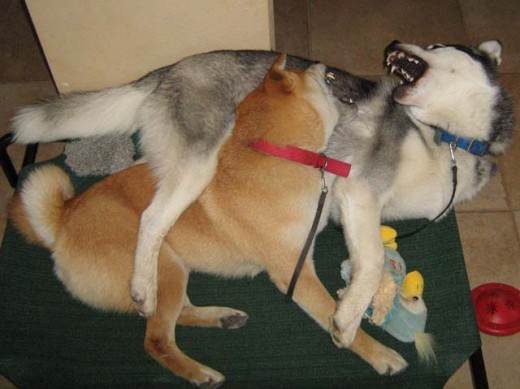
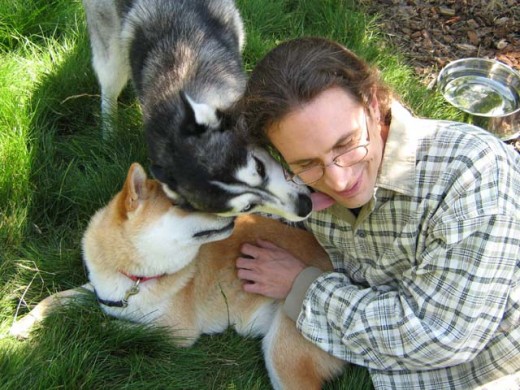
      Have to comment on the first two pictures you used for ‘aggressive’ dogs… the body language in those pictures is not of aggression… the second is most definitely play. The dog in the first one may be slightly annoyed, but I get the feeling this smiling is something he does in some situations. It may be a calming signal if he’s in a position he doesn’t like… It’s hard to tell from one picture. Perhaps you could use a picture of truly aggressive body language so that people don’t get freaked out by normal play behavior.

      10:55 am on August 21st, 2011 Reply
      • shibashake

        Hello Judy,
        Thanks for your very interesting comment.

        Dog aggression is an overloaded term. Likely, my definition of aggression will be different from everyone else’s.

        1. Normal dog behavior.
        Almost all of the aggression we see today with our companion dogs is a result of normal dog behavior. Food aggression, for example, is a dog telling the perceived “food thief” to back off. Over excited play can also quickly turn into something more intense.

        As you say, context is very important and it is simply not possible to tell from a single picture if a dog is being “truly aggressive” assuming that we mean the same thing when we say “truly aggressive”. Much of what we use to read dog body language is missing. Faces may not be visible, parts of the body may not be visible, and there are no motion or verbal cues.

        Even with multiple pictures it can be difficult to tell. This is why it is dangerous to follow techniques that we see on television because it is difficult to tell what circumstances are appropriate for which techniques.

        2. Truly aggressive dog.

        I am not sure what a truly aggressive dog is. If a dog growls to warn somebody away from what he perceives as his food, is that truly aggressive? If a dog bites based on the command of his owner, is that truly aggressive? If a dog bites because he is redirecting his over-excited energy, is that truly aggressive?

        A truly aggressive dog, or a dog whose intent is to do extreme harm or kill a human target, is very rare. Indeed domestication is all about breeding out these tendencies, and we have been very successful at that with our dogs.

        3. A bite is a bite.

        Whether a dog is truly aggressive or not, his bite will still hurt and may cause damage. For this reason, we all do our best to observe, train, and manage our dogs so that they do not find themselves in a bite-situation or really in any situation where they may inadvertently hurt others. Often a jump or a strong body bump can cause significant damage as well especially to the really young or elderly.

        One time I was knocked down by a young pit bull that was playing with my dog. I was standing still and a strong body bump knocked me off my feet. That hurt a lot and would have been worse if I were much younger or much older.

        Most of the time bites or other dog related injuries do not occur because of true aggression, but simply because of insufficient control or management.

        To me, the important issue is to make sure we are in control and that we do not expose our dogs to situations where they may accidentally cause harm to others and to themselves.

        4:40 pm on August 21st, 2011
    16. Georgia

      Hello,
      I just go my shiba inu puppy 4 days ago and so far its going pretty well except that he started humping me! When he does I put him in a time-out but it really bothers me and I don’t understand why he has started doing it all of the sudden. So far he has only done it to me and one random guest I had, but not my spouse. Also, he will sometimes bark right in my face when I’m holding him or even make a nasty growling noise. This last time he started humping me it was right after he barked in my face and it startled me. Is there anything else I can do besides putting him in time-out that will prevent him from humping? What did you do? And is there anyway I can stop him from barking or growling in my face? And when he does, how should I react?

      10:19 pm on August 16th, 2011 Reply
      • shibashake

        Hello Georgia,
        I went through a very similar thing with Shiba Sephy. In our case, it started because he started mouthing on my hands and arms, and biting on my jacket when we were out on walks. I became quite afraid from him because of this, and the fear caused him to become even more crazy. I was able to manage him in the house because I would just calmly put him in timeout but when we were outside, I started to feel stressed, and Sephy would become a crazy wild thing.

        For us, the most important and hardest part was to control my own fear and stay calm when Sephy was misbehaving. When Sephy started humping my leg, I would non-mark him – Ack, ack. If he does not stop right away, I calmly take him by his drag lead to timeout. The drag lead (only on a regular flat collar, not a training collar) is very helpful because it allows me to control him without him mouthing on my hand. Then I always ask him to do a simple command for me before letting him out of timeout.

        I remember that I felt lousy and somewhat betrayed when Sephy did his biting and humping on me. He didn’t do it to my partner. I thought to some degree that Sephy did not love or even like me and that was very hurtful. But later on, I realized that these behaviors have little to do with like or love and more to do with my own feelings of fear and uncertainty. Sephy is a very sensitive dog and he picked up on my stressed out energy. This caused him to get stressed as well, so he starts to act in an erratic fashion. This in turn made me even more fearful and so on. It was a pretty bad cycle.

        Other things that helped -
        1. Having a very fixed routine and a lot of house rules.
        2. Following the NILIF (Nothing in Life is Free) program. This just means that Shiba has to do something for me first before I give him anything in return (even affection, opening doors, etc.).
        3. Bite inhibition training.

        Here are some of the things that helped with Sephy when he was a puppy -
        http://shibashake.com/dog/puppy-obedience-training
        Here are some of the trials and tribulations (mostly trials) that I went through with Sephy in the first 6 months.
        http://shibashake.hubpages.com/_srec/hub/Shiba-Inu-Sephy-and-Me

        Also check out the Shiba Inu forum. There are many Shiba Inu owners there with a lot of good information.
        http://www.shibainuforum.org/forum/

        The initial first few weeks are the worst with a new puppy. Things will get better once a routine is established and Shiba starts to understand the rules and boundaries in the house.

        9:42 am on August 19th, 2011
    17. Scarlett

      I really enjoyed your blog about Shibas i have a 13 week shiba male and I am finding it very hard to discipline him when it comes to his agression. I feel like whatever method I use, he becomes more nippy in the moment. Can you give me some advice on what to do, to make sure he know we’re in charge not him.
      Thank you so much!!!!!

      9:54 pm on August 8th, 2011 Reply
      • shibashake

        Hello Scarlett,
        With Shiba Sephy, timeouts worked best for him. Trying to physically engage him only made him more crazy and mouthy.

        This article outlines some of the things that helped with Sephy. Some other things that helped -

        • Following the NILIF (Nothing in Life is Free) program. This just means that Shiba has to do something for me before I give him anything.
        • Having a very fixed routine and schedule. Shiba Sephy needs and likes to have routine and structure.
        • Exercise and play time. Shiba Sephy works for all of his food.

        Here are more things I did with Sephy when he was a puppy -
        http://shibashake.com/dog/puppy-obedience-training

        8:40 am on August 11th, 2011
    18. Emily

      Things are not going so well, actually. Our fight is usually over the leash. Every time I go to put it on him, which has never been a problem before, he attacks me. Unless he is just very excited to be going outside. His behavior is so strange to me. This is a dog who has never bitten me in his life. A dog who would sit patiently and allow me to put his leash on him at the door any time I wanted. And now he’s completely different. I’m very afraid of him, so I leave his leash on all of the time now so I don’t have to clip it on him. It’s a ridiculous method for covering up the problem, but he hasn’t attacked me since then either. I’m really very unsure of what to do with him. I would like to re-home him, but it’s impossibble to find someone who has the skills, or is willing to take in an aggressive animal. I love my dog very much. I’ve had him since he was a puppy, and we’ve never had problems before. But I just don’t know how to handle his behavior anymore.

      8:53 am on September 20th, 2010 Reply
      • shibashake

        Hello Emily,

        I think I know what you mean. I was in a very similar place with Sephy not too long ago. Your comment really got be thinking about my dark times with Sephy so I wrote about it here -

        http://shibashake.com/dog/afraid-of-your-dog

        It is my own personal story so much of it may not exactly match your situation, but hopefully some of it will help.

        11:11 am on September 21st, 2010
    19. Emily

      Thank you so much for replying to my comment. Do you think it may be possible for us to exchange emails?

      6:01 pm on September 13th, 2010 Reply
      • shibashake

        Hello Emily,
        The best way to reach me is to leave a comment on the website. I check it most often.

        You can also send me e-mail at -
        http://shibashake.hubpages.com/_srec/contact

        However, I don’t check and answer e-mail as often so there will probably be a larger delay in response time.

        How are things going with your Shiba?

        7:55 pm on September 14th, 2010
    20. Emily

      I recently moved, and this seemed to awaken my shiba inu’s aggressive behavior. He attackes all of my friends, and even me. I’m not sure what to do with him. I’m afraid to put his leash on him, or even spend time with him anymore.

      4:57 pm on August 28th, 2010 Reply
      • shibashake

        Hello Emily,
        Yeah, I experienced some of that with my Shiba in his younger days. Every time he got excited or when I stopped him from doing something, he would get wild and start jumping and biting at my jacket. I started really dreading our walks and became afraid of his wild behavior.

        Fear is really the Enemy though. Sephy’s behavior worsened the more fearful I became of him.

        The steps I took above really helped me during this time. The thing that helped me most is to get as much information as possible on the behaviors that I was most afraid of. I also observed him carefully so that I knew exactly the triggers that would cause those behaviors. Finally, I came up with a series of detailed steps that I would take whenever he started his wild jumping and biting.

        Once I had a plan, my fear lessened because then I knew what to do, and I would just focus on the steps. Not all of the plans worked, but if they did not, I came up with alternative strategies and something usually works out. This helped me become more confident, and as I gained confidence, Sephy’s behavior improved significantly.

        Observe Shiba carefully and see what his triggers are – does he attack when he is touched? approached? when people enter the house?

        As you described, moving is a big deal to a Shiba because it is such a big change to his routine. Dogs, especially Shibas really need their routine, so a big change like that could cause significant stress. Has he been more stressed than usual? Is he eating less? How does he act when he is alone? Has anything else changed – e.g. your schedule, your friends, frequency of visitors?

        Finally, his behavior could also be due to something physical. If he has accidentally hurt himself (hurt paw, tooth issues, etc.) it can also cause a change in behavior.

        A professional trainer can be very helpful in situations like this to help you identify the source of Shiba’s aggressive behaviors. A good trainer can also come up with a plan to help Shiba get over his stress and redirect his negative behaviors into something more positive.

        It will get better.

        Things got better with Sephy once I started getting more information, worked on controlling my own energy, and developed a variety of strategies to redirect his energy.

        Good luck – let us know how it goes.

        7:48 pm on August 29th, 2010
    21. Lisa

      Hi again!

      My Shiba Inu’s previous problems are mostly fixed now after lots of hard work but now he has taken to trying to bolt out the door by squeezing between your legs and the door frame. We have had him sit EVERY time he enters or exits our home from the time he learned how to sit to try to teach him boundaries. This did not seem to help obviously because now, in the middle of his 8 Month old adolescence, he decided there are just too many new things to find on his own and I’m in fear of him running off or worse, getting hit by a car or biting someone who tries to catch him.

      I need help! He is in obedience training but the trainer could only suggest what we’ve already been doing. I looked up some other websites to help me but they all taught dogs through negative reinforcement which we all know will never work on a Shiba…

      Thank you for any response in this matter!
      Lisa

      8:13 pm on July 25th, 2010 Reply
      • My Shiba Inu’s previous problems are mostly fixed now after lots of hard work

        Congratulations! That is very good to hear. The last really serious issue I had with Sephy was his leash biting and it felt so good when I finally got it under control.

        now he has taken to trying to bolt out the door by squeezing between your legs and the door frame.

        Some things that may help -
        1. Double gates/doors. I have installed double gates on my backyard – kindda like what you see in dog parks. Double gates are a great way to do door training because when Shiba squeezes through, he gets nowhere except straight to a time-out. It also makes things very safe. Some people set up a temporary pen right outside the door during training.
        2. Drag lead. Sephy always has a drag lead on (only on a flat collar). That way I have a better chance of catching him when I need to. When I was doing door training, I put on a longer drag lead on Sephy. When he tried to escape I would just step on the lead. If he didn’t try to escape he gets to go on a nice walk and I also played with him outside. This way he learns that -
        Try to escape = No walks and don’t get to go outside, Sit and wait = nice walk in the great outdoots.

        In general, you want to – a) prevent Shiba from getting a successful escape and b) reward Shiba for waiting nicely on doorways. If Shiba escapes, then he gets to be free outside which is a big reward from his point of view. This will definitely spur him on to try more escapes and be more creative in his escape maneuvers. However, if he keeps getting thwarted, and loses his walking privileges, he will think twice before trying anything.

        9:23 am on July 26th, 2010
    22. Going Mad

      I have a year old female Shiba Inu. She has great energy and is extremely intelligent. In the house, I can pull things out of her mouth, I can stick my hand in her mouth, I can pull her bowls away from her while eating and invade her space without problem. However, once we’re outside, her “protect my things” switch is flipped. I don’t bring any toys outside with me. But she always tends to find something and claims it. In the dog run, if someone will a ball comes in, I leave. Otherwise, she will grab hold of the ball and become viscous with anyone, even me. She has bitten my boyfriend numerous times when he was trying to get something out of her mouth. Her possession aggression outside of the home is getting very dangerous. HELP!

      4:04 pm on June 20th, 2010 Reply
      • Sounds like you already did a great job with her in terms of training her to “Leave-It” inside the house. Now you can just use similar techniques to train her outside. Dogs don’t tend to generalize commands across different locations – so a Leave-It command inside the house just means Leave-It inside the house. To them, Leave-It outside the house is a totally different command.

        I found that playing the object exchange game is a great way to get my Shiba to voluntarily give him stuff. I also practice Leave-It commands with him outside.

        When I first got Sephy, I used to take things out of his mouth all the time because he was always trying to eat something crappy off the sidewalk or road. This made him get even more possessive about objects when outside, because he associated me coming near him with taking stuff away from him (when he is outside). He was fine inside the house because he usually doesn’t get anything bad inside the house, and I didn’t have to go into his mouth.

        After doing a fair amount of retraining with Sephy he is better outside, but I try to make sure he doesn’t get the chance to pounce on anything bad. In general, it is best to reduce occurrences where you have to forcibly remove objects. In this way, Shiba associates taking away an object with getting something else back that is even better, rather than with losing a prized possession.

        Another thing that helped me with Sephy a lot is bite inhibition training. This really saved me later on when Sephy started doing crazy leash biting and sometimes biting on my hands when he redirected his frustration.

        In the dog run, if someone will a ball comes in, I leave.

        I think that is a very good idea because then, she does not practice her guarding behavior. The less guarding she does, the less likely it will become a habit.

        I would definitely consider getting a trainer to help with this. A trainer can help with timing and setting up training exercises, structure and routine so that we minimize the number of guarding episodes and increase the number of successes. In this way, Shiba learns that people coming near her does not mean that she will lose her items but instead, she will get something even better. Proper management is important so that she is protected from other people who might reach down to her when she is guarding.

        Let us know how it goes.

        7:56 am on June 22nd, 2010
    23. Chris

      My Shiba inu hates walking on grass and is perfectly content on the cement. When we take him outside we have to lead him onto the grass to eliminate and then directly after he will fight and pull to go back to the cement. Sometimes I know he has to poop but he refuses to sniff around to find a spot so he ends up holding it for long periods of time. I know they like to be clean but is this a little extreme?

      5:22 pm on June 4th, 2010 Reply
      • My Shiba inu hates walking on grass

        That is very interesting – Sephy is also like that but only for wet grass. He doesn’t even like playing on wet grass, so in the morning, he will only play inside the house. In fact, after it rains, he will avoid stepping on the wet door-mat when he goes out – lol.

        Sometimes I know he has to poop but he refuses to sniff around to find a spot so he ends up holding it for long periods of time.

        Yeah Sephy is very particular about pooping as well. The stars and moon have to align in exactly the right way before he will do it. He almost never does it in the backyard, and when we are out on a walk, there are only particular places that meet his standards of toilet excellence.

        If there is another dog or person about, or something is not quite right, then we must try again in the next spot – lol. I usually take note of all the good spots.

        I think it is another Shiba quirk :D

        8:42 am on June 6th, 2010
    24. Lisa

      Charlie actually enjoys being in his crate… He almost prefers it. Then again about 2 months ago he broke his leg and wasn’t allowed to move at all other than his outdoor business so he had no choice other than liking it because he was in there 24/7 for about 7 to 8 weeks. Something that helped him cope with it, I believe, is because we put a blanket over his kennel so he couldn’t see out which prevented him from seeing any desirable reason to want out. He is crated at night and while we are gone but if we don’t cover his kennel he will whine to and yip for attention to come out.

      5:05 pm on June 4th, 2010 Reply
    25. Lisa

      I have a Shiba Inu/American Eskimo Dog (I think he got more shiba genes than eskimo (: ) He is 6 months old this month and he is really well behaved as far as not biting or chewing on non-doggy friendly items or jumping on my 21 month old daughter… BUT if there is a situation that he does not like or if I reach down to him for any reason he unleashes the worst scream I’ve ever heard and even if I don’t let him go and I ignore the behavior until he stops he will do it for up to 10 minutes sometimes… I’ve heard the “shiba scream” in online videos and things but none of them shriek as loud and evil as he does. I wouldnt normally care and we would just ride it out and hope that it goes away when he is older but we have problems with our next door neighbors. They are very picky and look for every little thing and anything they can call and complain about… I fear that they will begin to complain about Charlie and force us to find him a different home. Sometimes he starts doing it outside at me and I have to bring him in quick because I swear it can be heard for miles lol. Does anyone have a similar problem or any advice on how to distract him from screaming without rewarding him for it? HELP please!!

      5:00 pm on June 4th, 2010 Reply
      • Hello Lisa,
        Yeah, Sephy used to do the Shiba scream with our dog walker. Being a dog walker, having a screaming dog in tow is definitely bad for business, so she would get pretty frustrated when he did that – which made him do it even more. Sephy is very good at sensing our inner energy and pushing the boundaries when he can :D

        BUT if there is a situation that he does not like or if I reach down to him for any reason he unleashes the worst scream I’ve ever heard

        Hmmm, many dogs, especially smaller dogs can feel threatened when we reach for them from above. Here are some of the things I did with Sephy to desensitize him to handling when he was younger -

        http://shibashake.com/dog/hug-dog-teach-your-dog-to-enjoy-hugging

        Depending on the situation and reason for screaming – I will sometimes also use the time-out technique for Sephy. If he is just screaming for me to open the door for example, rather than as a result of stress, I will just ignore him or put him in time-out. Initially, he would scream in time-out but after a few times, he learned that this had little effect so nowadays he just gives me the depressed look even though I let him out after a couple of minutes.

        Just make sure the time-out room is far away from the difficult neighbors :D

        8:33 am on June 6th, 2010
    26. Bart

      thanks for the website.
      I think we’ve realized that our shiba is not a dog that can be crated!
      he does value his freedom way to much and its torture to leave him in there.
      so, we’ve gated off a room and he gets to stay in there while we’re at work. he can look out the window and run around and he likes it better. we leave his cage in that room so he can go in and out as he pleases.
      luckily he is not destructive and doesnt use the bathroom indoors.

      the only thing im worried about is that he will claim that room as “his”. he is very dominant sometimes. he’ll nip at your feet when you’re not doing what he wants. but then he gets punished.. either leash correction or time out. but from what ive read, this is typical shiba. he’s such a little brat sometimes, but i love him!

      9:30 am on May 26th, 2010 Reply
    27. Bart

      Have you ever encountered any aggression when crating your dog?
      We just started (about 3 weeks now) crating our shiba when we leave the house and at night to sleep. He HATES the crate, even if we bribe him with a kong or other high value treats. He bites when you take him to the room with the crate. Then, once he’s in there, he’ll scream for hours. Any tips to get him to like it?

      6:44 am on May 24th, 2010 Reply
      • Yeah, crate training can often be very difficult, especially for a Shiba because they do so love their freedom.

        The thing that helped most with Sephy is to go very slowly. Many times during the day, I would just give him the crate command, he would go in, get rewarded, and I’ll let him come right back out. I did this until he was comfortable with the process, then I would close the door, and open it a few seconds later and let him come out.

        Then I very very slowly lengthened the time he stayed in his crate. After a while, he was comfortable eating a Kong in his crate and staying the duration. Nowadays he goes into his crate on his own at night.

        This article from the Humane Society has some good information on the crate training process -
        http://www.humanesociety.org/animals/dogs/tips/crate_training.html

        8:04 am on May 26th, 2010
    28. Colleen

      You posted in comment on here that you taught your Shiba to be “Quiet”….How on earth did you accomplish this? Reptar doesn’t scream (that has only happened once at the vet), thank goodness!! But man, he sure is a vocal little thing especially if we’re not giving him what he wants when he wants it. We ignore him and eventually he stops, but it would be wonderful to understand how to teach him “Quiet”.

      6:29 pm on May 4th, 2010 Reply
      • Hi Colleen,
        So good to see you.

        But man, he sure is a vocal little thing especially if we’re not giving him what he wants when he wants it.

        LOL – yeah Sephy can be very vocal too although he has quietened down a lot now that he is older.

        In terms of Quiet – it is just like any other command and Shiba will decide whether he wants to follow it or not. To first teach the Quiet command – do something that you know will trigger a vocalization but that will not trigger too extreme a reaction. For example – ringing the doorbell works for a lot of people. Let Shiba vocalize a bit then say Quiet and wait for him to stop. As soon as he stops mark the behavior and reward very well – then keep repeating until Shiba knows what the command means.

        After that it is just a matter of rewards and consequences in terms of whether Shiba will listen or not. There are also several different scenarios in which Sephy vocalizes – e.g. guard mode, whine mode, excited mode, etc.

        When in guard mode he will usually stop once I come to check out what he is barking at. Once he has alerted us, he has done his job so he stops.

        In whine mode – he will stop if he knows I really mean it. Another thing that helps here is to give him something else to do – e.g. go to your mat and stay. If he stays properly for long enough, he gets a good reward. Nowadays, he just goes to the mat on his own when I ignore him. I make sure to reward him when he does that :)

        Excited mode is the hardest so I usually just remove him from the stimulus.

        Strength of stimulus also really matters. When the stimulus is too strong – it is best to leave and that will usually help to quiet things down.

        How is Reptar? How are things going with finding him a girl? ;)

        3:28 pm on May 5th, 2010
    29. Alecia

      First off, I just wanted to say that I really enjoyed reading your article. But I was curious if your Shiba has ever had a problem with aggression towards other dogs? My boyfriend recently adopted a female Shiba Inu (about 2 years) and she is very sweet and great to take to the park and has never shown aggression towards either of us. The only problem is that I too have a dog, a female lab who is generally never aggressive (though fairly dominant). They walk side by side with absolutely no problem at parks or around the neighborhood, but with my dog off the leash the Shiba Inu turns into a completely different dog (growling, snarling, lunging at her). We are trying to deal with this behavior but we are having some difficulties. Please let me know if you have any advice for this- I feel as though we’re never going to be able to have our dogs off leash together.

      6:14 pm on May 4th, 2010 Reply
      • Hi Alecia,

        But I was curious if your Shiba has ever had a problem with aggression towards other dogs?

        Yeah – Shiba Sephy can be particular about his dog friends. In general, Shibas do not get along with other dominant dogs. There are also certain things that Shiba Sephy does not like – for example other dogs sniffing his butt. I later learned that especially for dogs that do not know each other well, this can be seen as a dominance move.

        One thing I noticed with Sephy is that he will not try to dominate other dogs, but if other dogs try to dominate him – he will not back-down and will not surrender.

        Some things to look out for -
        1. When both dogs are off leash who is the first to initiate interaction?
        2. Are there particular triggers/behaviors that Shiba dislikes? Sometimes it could just be an invasion of personal space. Shibas are pretty good guard dogs, and like other guard dogs (e.g. German Shepherd) they may not like other dogs crowding their personal space unless invited.

        When I meet outside dogs with Sephy I make sure to only greet more submissive playful dogs. I try to greet often but keep each greeting short. I also watch out for butt sniffing behavior and body block the other dog from doing it.

        For at home, I make sure that there is no bullying, and I interrupt play if it looks like things are becoming too high energy. House rules are that they must play nice and according to my rules. If they don’t, play stops and the one that went overboard gets to go to timeout. I also do not allow humping.

        One thing that may help is to leave drag leads on both dogs (only with a flat collar – *no* training collars). In this way you have more control and they may also act differently. It seems like they understand that when the leash is on, there is more structure and they know what the rules are. Similarly, it will be helpful to set up similar rules and structure for off-leash time.

        Here are some of Shiba Sephy’s experiences with other dogs -
        Socializing a Shiba Inu to Other Dogs
        Dog to Dog Aggression
        Getting a Second Dog

        The important part of keeping the peace at home is to carefully observe the situation and correctly identify which behaviors are causing friction. Often it can also be helpful to get a trained professional to come and observe the dogs interact. A good trainer knows how to read body language and can help accurately identify key stressors.

        1:42 pm on May 5th, 2010
    30. Hi Phillip,

      Should we try to do something about the first dog’s screaming?

      It may be best to stop it now before it becomes a habit.

      If she screams and you open the door for her after she has screamed for a certain duration, then she learns that – if I keep screaming long enough I get to go out. This encourages her to keep screaming and for longer periods of time. Your other Shiba may also observe this, and start following that behavior.

      What worked for me is to let my Shiba only vocalize once, then I tell him to Quiet (you may need to teach her the command first in a separate session). As soon as he quiets down, I ask him to sit, then I open the door for him. Then you can slowly increase the time that she has to stay quiet.

      If she continues to scream then just ignore her. It is best not to give her anything (even your attention) when she is displaying undesirable behaviors. If she escalates and starts jumping on people or biting people then calmly put her in timeout.

      In this way she learns the if she stays quiet she gets to go out, and if not, she doesn’t get anything.

      8:47 am on March 27th, 2010 Reply
    31. Phillip

      We have two Shiba Inus, and one of them will scream to get outside and to get back inside. We think it is fine that she makes a loud noise when she wants in because that is probably the best way for us to know that they are ready to come back in, but do you think it is something we should stop within the house. She only does it to get out, and the other Shiba never does it for anything that she wants. She’ll just prance around and look up at everyone in the room. She easily makes it clear that she wants to go outside without any noise. She also will wait for someone to walk by the door, then run to it to alert us that she is ready.
      Should we try to do something about the first dog’s screaming?

      8:57 pm on March 24th, 2010 Reply
    32. Derik and Kitsune

      Thanks a lot for all you help! I’ll let you know how it goes!

      1:50 pm on August 22nd, 2009 Reply
    33. There is a lot here – so please let me know if you have more questions.
      Oh yeah, energy is extremely important with a Shiba. Shibas are very sensitive to the energy of the people around them. Calm is the best energy for a Shiba when they are acting out – anything else will make them go even more nuts. :)

      1:49 pm on August 22nd, 2009 Reply
    34. Derik and Kitsune

      I guess in the end, I want to have him follow my rules without making him fear me. It sounds like too much to ask but I think it is possible. I just need footing to gain some momentum. Just to let you know this behavior really shows it’s face when he is extremely hyper or when a friend of mine plays with him. For some reason he just goes crazy around her!

      1:47 pm on August 22nd, 2009 Reply
    35. Derik and Kitsune

      Hi, I love your site, it is extrememly helpful!

      I just got a 10 week old Shiba pup and I’ve had him for a few days now and I want to train him right. Now, he doesn’t do this to me except when I let him out of his crate every now and then, but how do you correct for a puppy jumping on a person even if it is in joy? Also, when he does this he sometimes becomes quite mouthy, what should I do? Also, from what I’ve noticed, when I tell him no, like when he chews on my hand or something he isn’t supposed to chew on, he responds negatively and summons the dreaded Shiba scream. Is this him challenging my authority as pack leader? If so, how should I respond to this beavior? And I really don’t have a room that I can use as time out, what method would you recommend for correction?

      1:46 pm on August 22nd, 2009 Reply
    36. Hello Derik,
      Congratulations on your new Shiba pup :) As you have noticed, they are small in size, but large in personality.
      1. “how do you correct for a puppy jumping on a person even if it is in joy?”
      When your puppy jumps, simply tell the person to ignore him and turn away from him. It is important to practice no talk, no touch, and no eye-contact (no eye-contact is very important because that can be seen as attention). Just fold up your arms and turn away. It is also important not to step back because that will encourage the puppy to keep jumping forward. Just stand in place and turn away. As soon as he displays good behavior – i.e. non jumping behavior, mark him (Yes), and reward him with affection. As soon as he jumps again – go back to ignoring. This will teach the puppy that jumping gets him ignored but not jumping gets him attention.

      2. Mouthiness
      Shibas are a very mouthy breed. This article deals with puppy biting -
      http://shibashake.com/dog/puppy-biting-how-to-stop-puppy-biting

      3. Time-out
      If you don’t have a good room to put him in on time-out you can also try putting him on a tie-down. Just have a tie down in a boring place in a house where he can’t get to anything. I used to have a tie-down in my kitchen. So whenever I had to do a time-out, I would just clip his collar to the tie-down.

      4. Shiba scream –
      Shibas can also be somewhat vocal. Firstly, try to understand why Shiba is vocalizing. Sometimes Shibas will vocalize to alert you to strange noises or to something else being wrong.
      Sometimes however, Shibas use the screaming and whining to get what they want and to get attention. My Shiba has used it on dog walkers, dog trainers, etc to good effect. Don’t give in to the attention-seeking Shiba scream. Just ignore it, and Shiba will stop after he gets no response.
      I don’t think that the screaming is a challenge. The Shiba puppy is just trying out different behaviors to see which ones get him the best results. Many people give in to the Shiba scream, which will make Shiba practice that behavior more and more. If Shiba does not get a response, he will move on to something else.
      Here is an article on my training experiences with my Shiba -

      http://shibashake.com/dog/shiba-inu-training-secrets

      5. Shiba play
      It is best not to do any rough-play with a Shiba Inu, especially in the beginning. I don’t do any rough-play with my Shiba. I also do not play tug-of-war with him.
      Here are some ideas for Shiba play -
      http://shibashake.com/dog/dog-play-fun-games-to-play-with-your-dog-or-puppy

      My Shiba likes playing the flirt-pole and the water-hose game. Make sure you have strict game rules though, and make sure to stop very often and ask him for obedience commands so that he doesn’t get over-excited. The obedience commands will also teach him that play is contingent on doing what you want first.

      1:48 pm on August 22nd, 2009 Reply
    37. Absolutely :) Thanks for all your comments rchicaferro. They provoke much thought, and that is an invaluable thing!

      1:45 pm on May 22nd, 2009 Reply
    38. rchicaferro

      Lots of important points! Well done!

      This ties in very nicely with your other HUB on not treating your pets like people – As much as we love our dogs they are not people and they require a lot of time and training to make their lives (and ours) more enjoyable.

      1:44 pm on May 22nd, 2009 Reply
    39. Ha! ha! ha! ha! ha! ha! ha! ha! ha! ha! ha! (transleted from LOL!)

      1:43 pm on May 22nd, 2009 Reply
    40. Quicksand! I haven’t seen you in ages. Been missing your ugly mug :-)

      What have you been up to?

      1:42 pm on May 22nd, 2009 Reply
    41. Good to see you Peggy. Yeah I really regret how things went with my first dog. I think it would have turned out better for everyone if I did A LOT more research before getting a dog.

      At least the second one got a smoother ride. I guess it is always toughest to be the first – in most things :)

      1:41 pm on May 22nd, 2009 Reply
    42. Thanks Tom. I don’t think you will really need it. Most dogs come with a pretty good temperament and it is usually the dog owners – like me :) – who inadvertently make them aggressive.

      1:40 pm on May 22nd, 2009 Reply
    43. You have a way with dogs. You are really brave! :)

      1:39 pm on May 22nd, 2009 Reply
    44. It is debatable whether we have EVER been the pack leaders but fortunately for us we have had a number of sweet and lovable dogs. Good article.

      1:38 pm on May 22nd, 2009 Reply
    45. This is a great article. We want to get a dog someday, so I will keep this as one of the reference I will use during training.

      1:37 pm on May 22nd, 2009 Reply
    46. Thanks Iphigenia! Sadly, the aggression was primarily my fault. I did not do enough research initially and used the wrong dog training methods with him. Luckily, he is a small dog, so although it was not very pleasant, I was at least able to handle it :)

      “he and his owner go everywhere together – the owner on rollerblades being pulled by the dog…. ”

      lol – gotta love Siberian Huskies. I usually jog along with mine, but I think rollerblades are probably more her speed. And Sibes can *really pull* :D

      1:36 pm on May 22nd, 2009 Reply
    47. Whilst I found this interesting – and so well written, researched and illustrated to your usual excellent standard – I could not imagine ever coping with an large aggressive dog. I have two dogs who are not submissve but have never displayed aggression. They have just accepted me as their food provider and carer – they seem to trust me implicitely and do what I say … but that is not because I have been good at setting myself up as the leader of the pack – I have been lucky in the dogs that I’ve homed.

      Thanks for another great read – BTW – there is a beautiful Siberian Husky in one of the neighbouring villages, he and his owner go everywhere together – the owner on rollerblades being pulled by the dog….

      1:35 pm on May 22nd, 2009 Reply

    Leave a Reply

    Your email address will not be published.

    You may use these HTML tags and attributes: <a href="" title=""> <abbr title=""> <acronym title=""> <b> <blockquote cite=""> <cite> <code> <del datetime=""> <em> <i> <q cite=""> <strike> <strong>

    search button search button
    rss