Leash training a dog, is effectively achieved by teaching him one simple fact-
Instead, walking properly next to us, is the quickest way to get to his destination.
To teach this lesson, it is important NOT to reward our dog for pulling.
Do not let our dog drag us along, and do not pet or give him any affection while he is pulling. Teach him to walk on a loose leash first, before attempting to walk him close to us in a heel position.
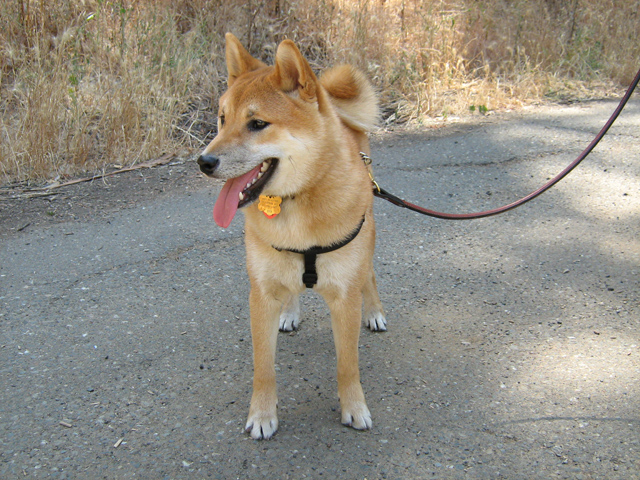
Here are some leash training techniques:
1. Red-Light, Green-Light
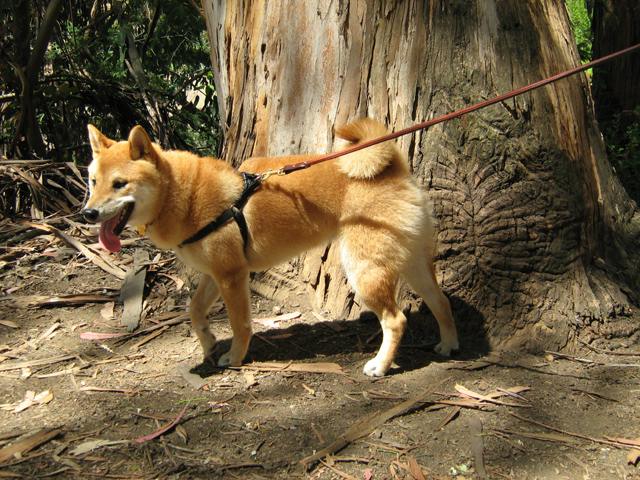
A simple way to leash train a dog and teach him not to pull, is to …
- Stop walking when the leash is taut, and
- Start moving again when the leash is loose.
We do not even need to say anything to our dog. Through our actions, he will figure out the rules of the game.
When we stop, some dogs may decide to roam around and smell whatever is available in the environment. To stop this, I usually shorten the leash and bring my dog in next to me. This does a better job at limiting his freedom, which makes this technique more effective.
In addition, I only start moving again after my dog does a Sit next to me. I use a shorter lead in the beginning, then slowly lengthen it if my dog walks nicely, and without pulling. By changing the length of the lead, we can control the amount of freedom our dog has, and further motivate him not to pull.
Initially, we may need to stop very frequently, so be ready for really short walks. However, it is important to be patient and absolutely consistent with the stop rule. Otherwise, our dog will learn that if he pulls enough times, we will give-in and let him go wherever he wants. This encourages him to pull more in the future.
2. 180 Degree Turn
Depending on the age and temperament of our dog, frequent hard stops may cause him to get frustrated. Too much pent-up frustration can make a dog act out in other ways, for example, he may resort to leash biting.
If we are training an easily frustrated or excitable dog, it may be more effective to use the 180-turn technique.
As soon as our dog starts to pull, quickly turn around and start walking in the opposite direction. In this way, the dog can release his pent-up energy, because he is still doing something physical – walking. At the same time, he learns that when he pulls, he just gets farther away from his desired destination.
If our dog walks properly on a loose leash for a few seconds, we can mark him for his good behavior (Good), turn back, and resume our walk. If he starts pulling again, it is fine to walk back and forth on the same stretch of ground until he learns not to pull.
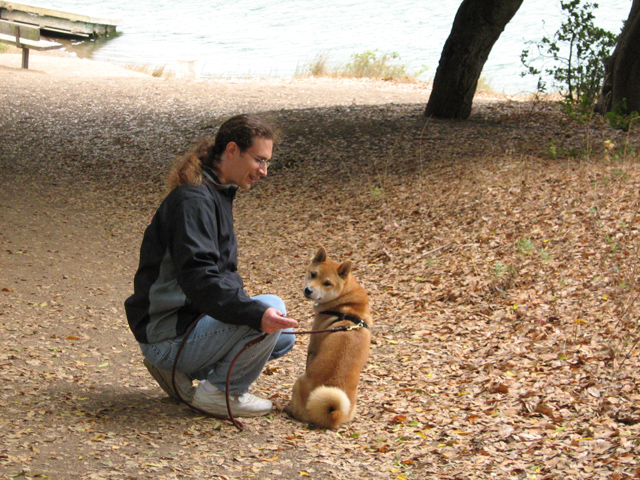
3. Hand Targeting


Start by training the dog to target our hand at home.
First, I put some dog treats in my hand, and make sure my dog knows that it is there. Then, I put my hand close to his muzzle and say Nose. As soon as my dog touches my hand with his nose, I mark him (Yes) and treat him. I repeat this exercise until I am confident that he has learned the command.
Next, I move a few steps away, put my hand out in the same gesture, and say Nose. When he moves toward me and touches my hand, I mark the behavior (Yes) and treat. I keep repeating this inside the house, then continue the exercise in the backyard.
Once we are comfortable doing this in the backyard, we can try using this technique outside.
If the dog pulls, non-mark him (Uh-oh), get him to do a Sit, re-target him on our hand, and continue the leash training session.
In this way, our dog learns that pulling is inappropriate, and walking close to us will get him affection and treats. We can treat less often, and slowly phase out the treats altogether, once our dog learns to walk calmly by our side.
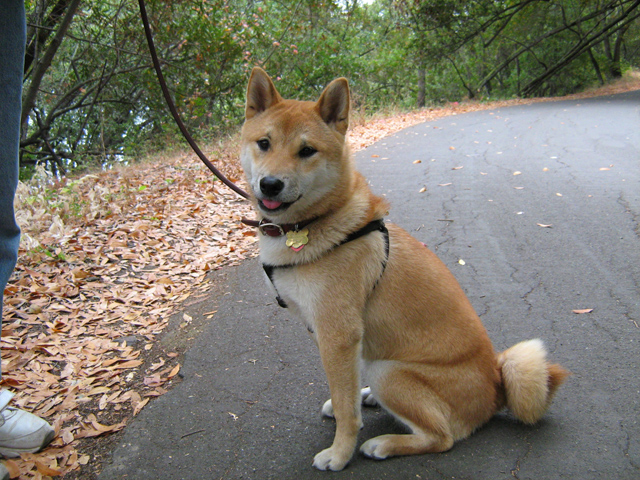
4. Collar Correction/ Leash Correction/ Leash Jerk
The most common aversive technique for leash training a dog, is to perform collar corrections (also called leash corrections or leash jerks).
A collar correction must be a quick jerk of the leash. There is only tension for an extremely short amount of time (a quarter-second or less), and then the leash should be loose again. Most people tend to do tugs rather than jerks, which will do little in training the dog.
Tugs may actually exacerbate the situation, because it places continuous tension on the leash. This tension may cause the dog to get tense and frustrated.
We must also be properly positioned for the collar correction, so that the force is always to the side rather than directly back. Jerking to the back may encourage the dog to lunge forward to oppose the force, thus causing him to pull even more.
To work well in leash training, collar corrections must be executed with the proper force, proper timing, and proper redirection. This is necessary so that the dog learns that pulling is wrong, without becoming afraid of his surroundings, or distrustful of his owner.
If not properly implemented, a collar correction may backfire and cause additional behavioral problems including dog aggression.
Only use collar corrections as a last resort. Only use collar corrections under the direction of an experienced professional trainer.

How to Stop Dog Pulling
Some dogs and some dog breeds will pull more than others. For example, I have two Siberian Huskies, and they both pull more than my Shiba Inu, because Huskies are bred to pull. However, by starting training early and being very consistent, even Huskies can be trained to walk at a measured pace by our side.
In the beginning, I leash train my dog in the backyard, where there are very few distractions. Once my dog is comfortable walking there without pulling, I move on to more quiet areas of the neighborhood. Another alternative is to walk during off-peak hours, where there are fewer people and dogs around.
By carefully choosing our training environments, we can set our dog up for success, and help build his confidence. Once he is comfortable walking in a given area, we can slowly increase the level of distraction.
Before we know it, we will be enjoying a wonderful neighborhood walk with our dog! 😀
Thank you for clear, concise instructions!
Thank you for the positive input.
Hope you are still reading comments, Shibashake! I realize the most recent comment was in 2014. So glad to have come across this site though! My shiba inu is currently 4.5 months old and isn’t walking well with the leash. He is afraid of car sounds, especially loud revving, and the main reason he is pulling on the leash is because he’s so afraid he wants to rush home. I’ve been exposing him to cars and busy streets every day since I first brought him home at 2 months, but no improvement. I feel bad that he’s still anxious outside and not enjoying our walks.
Oops never mind the most recent comments was in 2016, not 2014 :p
what is the exact leash and harness he uses?
I desperately need help. We got a standard poodle puppy to help our traumatized daughter (our son and my mother both passed away suddenly in a 3 month time span and she is having a difficult time with grief). 2 weeks after we got her I found out that I am pregnant. High risk due to tumors on my womb. It’s important that I not be knocked down. The puppy is kind but huge and I am unable to work with her. She now lives in a cage 24/7. I cannot get rid of her and further traumatize my daughter and let me say again she is a very sweet dog. But she does not calm down. She jumped on my belly several times while I was laying on the sofa and my husband got her out to go outside. She is terrible on the leash, it’s difficult even for him to not be pulled to the ground by her, let alone me. (She is now 7 months). She is starting to show aggression toward our other dog who is very old and has no teeth to defend himself. I believe her aggression is from being caged but I physically cannot take her out without risking the baby’s life and possibly mine. My husband works 12 hour shifts with 2 days off per week. It’s just not enough time out of the cage. Any advice you can give would be tremendous. When we can work with her (carefully, of course) she is not interested in treats or toys as rewards. The breeder came over to help us but I can not possibly do the submissive position with her, she is too big and strong and I am far too fragile. It did work, that one night that she worked with her like that she (for the only time ever) calmly laid next to me and didn’t jump on any of us. Any advice that you can give is so very appreciated.
get a good home forthe dog . you have a life full of other things its not fair on the dog if you do not have time to train him
Thank you so much for all these AWESOME articles!!! I’m getting a black-and-tan Shiba Inu soon – still waiting for the breeder to inform me 🙂 Your articles are truly helpful for both experienced dog owners and noobs like me 😛 Keep up the good work!
Thank you so much for this fantastic outline! I just brought home a Aussie Shepherd/Border Collie mix (they think). Six months old, gorgeous, and with some reinforced bad habits from the shelter (jumping to greet and jumping up on the couch). Two time-outs in a row has worked to keep her off the couch during her first morning, and the Red Light/Green Light made our second walk a great success. She’s smart and energetic enough that sitting between “pulls” was frustrating her, but stopping and ignoring has worked wonders! Here’s to another five walks today.
That is so good to hear. Congratulations on your new furry friend and big big hugs to her. It is always so wonderful to hear of a dog finding a great home. You are awesome sauce! 😀
Hi, my 1 year old golden retriever pulls really hard when we walk. I’ll admit I’m no expert, I’m 18 and I do my best honestly. I wonder if these methods will work if i’m the only one to use them in walks, but my family members don’t? Unfortunately my family situation is extremly complicated, we have so many issues and barely function so there is just no way going around it and discussing about our puppy, I’ve tried and it led nowhere. So basically it’s just me and him – with them doing nothing or the opposite of what I’m trying to teach him. Can I do it alone?
Hello, we got ourselves a shiba inu puppy, and we are having quite trouble with him, he does not react on his name, cries when he is in his improvised fence (we made him a big by placing things he can´t pass around him, it´s about 3 mx 2m, we builded it, because even though we made many places to pee for him in house, crates, newpapers… etc., like literally two in every room, he still “goes” somwhere else. When we leave him there at night, he always cries, waking up our neighbours.) and most importantly, if he notices he is on leash when outside (when the leash gets taut) he starts wriggling and crying as if someone would literally beat him… people walking around are just looking at me, thinking I am beating the poor puppy. I am not even pulling him… the leash just gets taut when he goes a little bit further.
How I trained my puppy.
Structure and teaching my puppy self control.
http://shibashake.com/dog/train-your-puppy-to-walk-on-a-leash
we are going to use these commands for a new Siberian husky puppy! we are doing this for a project he is 7 weeks old I hope they work