Walking with a 3 Legged Dog

Walking a three legged dog on a leash, can sometimes be a challenge.

Three legged dogs find it easier to walk at a faster pace, and may have difficulty making quick or sharp turns.

They also have less balance, and are more prone to falling down.
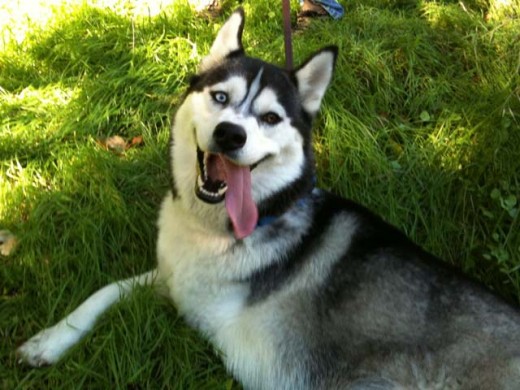
1. A Harness Can Provide Support

Using a harness can give our three legged dog more support, when we are out on a walk. I found this to be especially helpful, in the beginning.

We can also use the harness to quickly and safely turn, restrain, or move our dog. This is useful to stop a tripod dog from running ahead, and to get her safely away from dangerous objects, for example broken glass.

I was using the Ruffwear Web Master Harness on Shania, and it worked out well. It is strong, provides good back support, and has fleece material over the leg straps, so that they do not overly chafe her at the joints.

However, this harness may limit air flow during hot days, and cause the dog to heat up more easily.

Another weakness of using a harness is that it gives the dog a lot of pulling power. Shania has very strong prey-drive, so it was very difficult to control her pulling, whenever she spotted a squirrel, cat, or deer. For leash training exercises, I find that it is more effective to use a thick, no-slip collar.

2. How to Stop Pulling

Being a Siberian Husky, Shania does a fair amount of pulling during walks. To stop her from pulling, I have tried using the Gentle Leader head halti.

The halti works well in controlling the direction of her head, and redirecting her away from undesirable objects and situations. However, Shania really dislikes wearing it, and she will occasionally plop down on the ground in passive protest. It is difficult to get her up again, by just using the head collar.

The same applies when she decides to hang back, dig in, and not move forward. For dealing with these situations, I usually have Shania’s collar or harness on, in addition to the halti.

Also note that the head collar is not a long-term solution. It does not train our dog not to pull, but just prevents the pulling. Once we remove the halti, our dog will likely start to pull again.

To train Shania not to pull, I use a combination of hand-targeting and treating, when she is voluntarily walking by my side. If she starts to pull, I first give her a verbal warning to slow down. If she does not listen, then I stop her, make her do a Sit and Wait, re-target her on my hand, and then move on. When I am using a collar instead of a harness, I sometimes use my hand to hold back her chest. This gives her more support, during a forced stop.

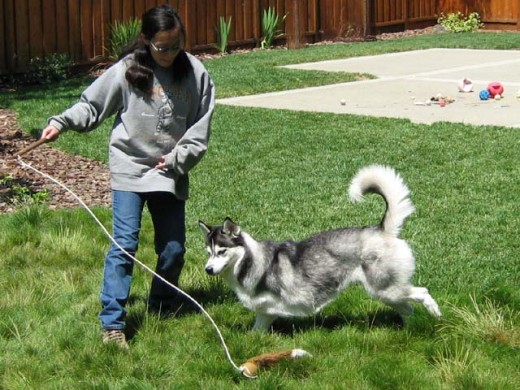
Some trainers suggest doing a 180-turn-around, to stop pulling. This does not work as well with three legged dogs, because forcing them to turn quickly may cause them to fall, and place undue stress on their feet. When I need to turn or change direction, I make sure to do it slowly, and at a pace that Shania is comfortable with. It is also possible to use leash-jerks to discourage pulling, but I do not use aversive techniques for a variety of reasons.

Nowadays, I almost always use a flat collar while walking Shania. She is better at walking now, and although she still pulls when she sees a squirrel or other prey, she will usually stop when I tell her to. I use the Premier Nylon Martingale Collar, which works very well for preventing collar escapes. It is also nice and thick, which helps to distribute the force around the neck, when a dog pulls.

Shania seems most comfortable with just a flat-collar.

3. Short Walks and Rest

Three legged dogs tire more easily, so take them for short but more frequent walks. During longer walks, make sure to stop often (in a shady spot if possible), provide plenty of water, and keep our dog cool.

Three legged dogs will take some time to build up their walking stamina, so start with brief walks, and increase the distance slowly.

Stairs, uneven ground, and raised surfaces, may be difficult to navigate, so be patient, and provide help as necessary.

4. Protect Our 3 Legged Dog

Three legged dogs may feel more vulnerable in the presence of new dogs. When threatened, there are four possible dog responses – fight, flight, freeze, or appease. Conditions are often fluid, and a dog may decide to change from one strategy to another.

My Husky Shania deals with unknown dogs, mostly through appeasement. She will roll onto her side or back, and offer them her tummy. Sometimes, when there are highly active dogs nearby, she will choose to run away.

It is important to step in, and protect our three legged dog from unwanted attention.

Sometimes, I bring Shania to a dog playgroup. When there are overly hyper dogs about, I step in and body block them away from Shania. In this way, she does not have to deal with stressful situations alone. If necessary, I do the same when she meets new dogs during walks. By keeping things positive, she will hopefully gain more confidence, and feel more comfortable when interacting with her dog friends.

Be vigilant and keep bad social experiences from occurring, as that may cause our three legged dog to become fearful. This may ultimately lead to dog aggression, depression, or other dog behavioral problems.

In fact I would step in and protect any of my dogs from rude dogs and rude people, although I have to admit that I am more protective over Shania.

If we have multiple dogs, be aware of how the whole pack acts in the presence of unfamiliar visitors. The rest of the pack may feel the need to protect their more vulnerable sibling, and become aggressive to other dogs.

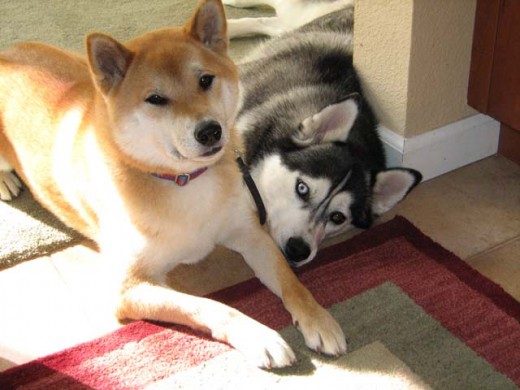
My Shiba Inu is very protective of Shania. I always supervise very closely when introducing them to new dogs. Usually, I keep Shiba on a lead, and let Shania interact with the new dog first. Once they are getting along fine, I let Shiba loose, and continue with close supervision. If Shiba displays any aggressive behavior, play stops, and he goes on a mini time-out. What the whole pack should understand, is that we are in charge of their safety, and we do the protecting when it is needed.
5. Socialize Our 3 Legged Dog
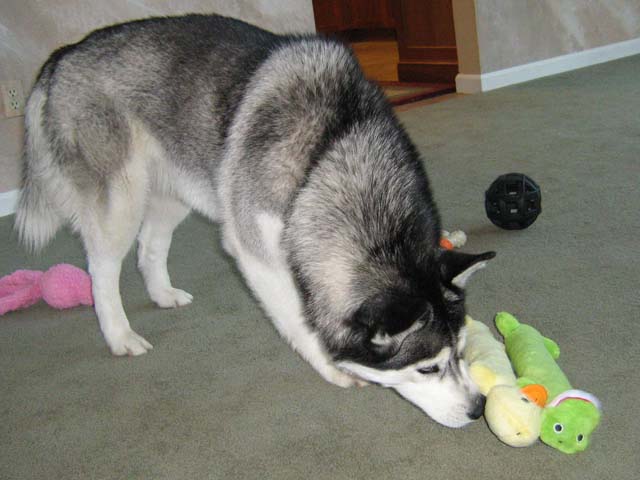
Note that three legged dogs may feel more vulnerable, and may be more fearful of new things.

It is important to socialize our dog to as many new experiences (garbage truck, umbrella, all types of people) as we can, so that she gains confidence, and is less likely to show fear aggression.

Let our three legged dog approach new experiences at her own pace, and make sure to reward and praise her well for taking small steps.
Related Articles

Comments

  1. hi there, im in the uk and ive sadly just lost one of my best friends my lilly dog she left her 3 legged brother behind and we are now trying to get him out and about to keep his mind active and his body healthy. im glad i came across your site its fantastic and very helpful. im always worried his other legs would suffer if i walked him and i now know its safe to just like any other dogs. thank you i wish you well

  2. Thank you for all the great advice.

    My boyfriend and I recently adopted a 1 year old 3 legged dog in Thailand. Your advice is extremely helpful but I’m curious if its entirely applicable because our guy is missing one of his hind legs. Thoughts?

    Thanks again,
    Cam

    • shibashake says:

      There are certainly differences between missing a front-leg vs. missing a back-leg, however, there are also many shared experiences with all three legged dogs. In addition, all dogs have different temperaments, will be motivated by different things, and will likely have differences in terms of what they excel in, and what they may have more difficulty with.

      I talk about many of my experiences with Shania in the article above, and some of them may apply to another dog, while some will be less so. One of the most important lessons I learned from my Shiba Inu, is to be flexible and to listen to my dogs. I make sure to modify training techniques to suit their temperament, their needs, and based on what they say to me through their body language and behavior.

      Is there something in particular that you feel is very different for a dog that is missing his back leg? If so, please let me know so that I can add that into the article.

      Thanks and big hugs to your new furry companion!

  3. Thank you for the information on this website! Our 4 year old Great Dane, Scoobert, had his left front leg amputated on Tuesday…cancerous tumor in his elbow. This is his second night at home. Looking for any advice. Tonight he wouldn’t go outside to go to the bathroom and I know he had to go. Fully expecting a huge mess in the morning. We couldn’t even get him to sit up to get a towel under to help him stand. He’s 150 lbs so lifting him isn’t an option. He’s begrudgingly gone out since coming home and always needs lots of assistance to stand, but tonight he just wasn’t having it. Any suggestions on where we go from here? We’ve tried coaxing him with treats, food, commands etc. when does it start to get easier? So sad to watch him like this. Thanks.

    • Hello Jaime,

      How is Scoobert doing?

      One thing that helped with Shania after the amputation is that we had a potty pad area for her in the house. In this way, she only had to walk a few steps to get to it. Size is an issue though, because we don’t want the pads to slip and slide. We had a potty pad holder, but I am not sure if those will be big enough for a Great Dane.

      Another possibility is to get a tarp or something similar (i.e. something that doesn’t absorb smell and that we can throw away later). My breeder does that when she has puppy litters. She secures a tarp really well onto the floor, and if the puppies go on the tarp, it is much easier to clean, and she can just throw the whole thing out after the puppies are grown.

      Sometimes, though, the dog may not even want to get up. My Sibe, Shania got bitten by a rattlesnake recently, and she spent a couple of days in the emergency hospital. They told us she did not want to get up at all the first day and a half. They just let her do her stuff in-place (on towels), and then gave her a bath after she started to feel better.

      In terms of recovery, that is probably very variable. Shania had a very short recovery time because she was very young and still small, when the amputation was performed. I would chat with his vet and see what he says. Also, check-out http://tripawds.com/forums/ . A lot of good information there and many people who have gone through the same thing.

      Hugs to Scoobert. Let us know how he is doing when you have the time.

  4. My dads Pomeranian had puppies 9 Weeks ago (she only gave birth to two) & one of them was born with no paw, so her leg isn’t completely gone but not enough to put weight on it. I ended up keeping her. & after reading about the harness u use I was wondering if u could use a regular harness or does that not provide enough balance?

    • shibashake says:

      Hello Rikki,

      The trouble I had with regular harnesses is that many of them would not stay on properly. The extra material of the Ruffwear helped it to stay on more securely, whereas the lighter weight harnesses often did not stay in place (because of the missing leg).

      However, Shania is a much bigger dog, and it may be different with a smaller Pomeranian. Let us know how it goes.

  5. Thank you for writing all of this material about caring for a tripod. I adopted at the beginning of October and ended up adopting a 4 year old tripod shepherd/chow mix. He had been in the shelter for 2 years and my heart immediately melted for him; so I knew I had to take him home…but wanted to make sure I knew how to take care of him properly (considering any particular situation).

    His leg was amputated 2 years ago, so he’s adjusted to it already and can out-run most of the other dogs we encounter in the fenced yard in my apartment complex. He absolutely loves playing fetch and would go on forever if you allowed him to. We also average at least 2 walks a day, ranging somewhere between .75 to 1.25 miles (each walk).

    Thank you again. This has become my ‘go to’ location for any questions I have while still learning what I need to be sure to do to make sure he has the best home possible.

    • shibashake says:

      Four paws up and a great BIG WOOF to you for saving him. He must be a really handsome guy being a Shepherd and a Chow.

      He absolutely loves playing fetch and would go on forever if you allowed him to. We also average at least 2 walks a day, ranging somewhere between .75 to 1.25 miles (each walk).

      That is so good to hear that he has finally caught a break and found a great home and a great companion.

      Shania sends many magical licks! :D

  6. Kathryn miller says:

    Hello thank you for your website. My husband and I recently rescued a tri paw, he is three yrs old, and seems despondent. How long does it take to get his pep back? He just wants to lay in the corner..is hard to get outside for potty breaks etc

    • shibashake says:

      I think it depends a lot on the dog and his history. Dogs that have a more difficult history will take more time to adjust to a new environment and new people. Did he just have his leg amputated? Or did that happen a while ago? Was it a result of a car accident or something else?

      Generally, I try to give new dogs their space and let them come to me in their own time. Dogs generally love food, so I find that it is a good way to get my dogs motivated. My Shiba is a pretty aloof dog, but he will usually move his butt when he smells me cooking sausages. :D

      What breed is your rescue? Breed characteristics are also a good way to identify good motivators for a dog. My Sibes, for example, love to pull, run, and they like chasing games (high prey drive). How long have you had your rescue?

  7. I’m about to have my beloved 10-year old Cairn’s (her hame is Rua) left front leg amputated due to an aggressive, but localized (thankfully) sarcoma that has come back twice. Other options were 4 weeks of radiation/chemo five time a week away from home, or a drug that would delay the inevitable. I chose amputation for her for a variety of reasons, mostly that it will give her the best chance of having a ‘normal’ lifespan, and because I will be with her during recovery, and she will be in her home for complete support. I thank you for this wonderful site and the articles. They give me lots of hope and tips on how to handle both the emotional (on my part) and physical (on her part) challenges that she will face. I live in a remote area where there is no access to hydrotherapy, so I’m thinking of a deep kiddie-pool for her swimming needs, supervised, of course. How long do you walk or exercise your sweet husky? How do you care for her pads and feet? How did you help her find her balance when it first happened? Thanks, so much, again. We will keep you in the loop!

    • shibashake says:

      How long do you walk or exercise your sweet husky?

      Shania is almost 5 now. I walk her every day but she mostly likes to rest outside, in the shade, and look at people or greet people. We stay out for over 2 hours or more, but we don’t cover very much distance. I let her set the pace and tell me when she wants to relax, smell, and look. She is more active in cold weather.

      How do you care for her pads and feet?

      I used to put Dermapaw on her pads, when she was younger and more active. Now she does not seem to need it. I do check her pads after we go walking on nature trails to make sure that there are no grass seeds or anything else that get stuck in them. I also try to trim her pad fur. If it gets too long, she may slip on it.

      How did you help her find her balance when it first happened?

      Shania got her leg amputated when she was very young – a few months old. The bones in her front leg didn’t connect, so the leg wasn’t ever weight bearing. I think because she never had use of the leg, and because of her age, she very quickly got used to walking on three legs.

      I recently talked to my vet about hydrotherapy and he didn’t think she needed it yet. As I understand it, hydrotherapy is often used in cases where the dog has difficulty walking. The water helps to support the dog’s weight, and this enables him to exercise and rebuild leg muscles.

      Big hugs to Rua. It warms the heart to see that she has such a good and caring family. Please give us an update when you get the chance.

  8. I love your page! My husband and I rescued a tripaw named Winnie almost a year ago and I found your site very helpful! Winnie had her leg amputated at 4 months and she is now 1 year old, but she has NO idea anything is missing lol. She could be a champion musher the way she runs at the dog park! My other dog, Lola, is also protective of Winnie, so it was nice to read that your dogs are this way too. Keep up the great work!

    • shibashake says:

      she has NO idea anything is missing

      That is so true! Shania is like that as well. I often wish she would be more careful. :D

      Many thanks for your awesome comment and BIG hugs to Winnie and Lola!

  9. Thanks so much for all the tips on caring for a 3 legged dog. My family just adopted a 5 month old tripod yellow lab from a rescue. She has had zero leash training what so ever and always had access to a doggy door. I am having a lot of trouble taking her out on a leash. She doesn’t even follow me. Sometimes she tries to take off running and falls when the leash jerks. Other times I try to get her just to follow alongside me and she would rather just sit and stare off in the distance or lay down and eat leaves. Sometimes she runs from side to side and all around my legs with no direction at all. I bring treats along and try to keep her moving at a good pace next to me with treats but half the time she is just jumping up alongside me. Suggestions?

    • shibashake says:

      Hello Kimberly,

      Congratulations on your new puppy and 4 paws up for adopting a dog in need.

      In terms of leash training Shania, I mostly use the start-stop or red-light, green-light technique. Essentially, I only walk when the leash is loose. When it becomes taut, I stop. Here is more on leash training techniques.

      I first start leash training in a very quiet area with few distractions, e.g. my backyard. I use a no-slip collar and a leather 6 foot leash. I usually start by only giving puppy a medium amount of lead, so that I have better control. If she walks well, I slowly give her a bit more lead and more freedom.

      With Shania, I slightly modified the start/stop technique by including a count before stops. When I start counting, she knows that she should slow down. If she slows down, I stop counting. If she does not slow down and I reach to 3 then I stop.

      With Shania I also stop a lot to let her rest. When it is time to move on, I give her the ‘Stand’ command (previously trained) and reward her for that. Then I reward her for walking well beside me, or we sometimes play the “Find-It” game to make the walk more fun. I make sure not to reward her for unwanted behaviors, e.g. jumping. Instead, I ask for an alternative command, e.g. Sit, Spin, Find-It, Come.

      Big hugs to Puppy!

    • Kimberly says:

      Thanks for the advice. Leonie is settling in well. I will try some of those techniques for getting her to walk. Did you experience any crying after Shania had her operation? Leonie is 2 weeks preop and sometimes seems to whine or cry for what seems like no reason. I don’t know if this is pain or her missing her old “home” or her just begging to play outside.

    • shibashake says:

      Hello Kimberly,

      Yeah, Shania did cry occasionally after her operation. They were very brief cries, and reduced in frequency with time. I think it may be due to Phantom limb syndrome.

      Big hugs to Leonie!

  10. I just want to say this: You are a wonderful, kind, loving, considerate, compassionate, informative, sensitive, generous and VERY much appreciated human being. Thank you SO much for time and help. Kia xx

  11. Hi,

    I have a 12 yr old husky who just had his front leg amputated. It has only been a week but he is having a lot of trouble getting around and maintaining balance. I think it will help a lot to use a harness with him, but i cant do that until his wound heals. Do you have any recommendations for physical therapy, or somehow teaching him how to walk on 3 legs?

    Thank you,

    Nicki

  12. I recently rescued a Golden Retriever puppy born with three legs and one front deformed leg she is very sweet she is 7 weeks old now and i am trying to find a wy to get her a prosthetic leg do you know where I could get that for her? My vets around here have no idea. I am in California. I really found your article on your dog helpful also I ill get higher food and water dish. Thank you Tina

  13. kelly robertson says:

    Hi ! We have a 20# husky mix 14 week old puppy Kona she was attacked as a newborn and lost her front left paw we also adopted her brother who is 50#. They love to go for walks and I recently purchased a harness for him that works wonderfully but did not know if it was recommended for a 3 legged dog. What do you think would work best for her at her age-she definitely pulls and loves to be the leader when we walk!
    Thanks for your article it very insightful:)

    • Hello Kelly,

      I used the RuffWear harness with Shania when she was young. I liked it very much because it had a lot of material around her torso and was secure on her even though she was missing a front leg. The problem with a lot of lighter harnesses is that they may slip and come off a 3 legged dog because of the missing leg.

      However, as Shania grew older and became much larger, the harness just gave her too much pulling power. I am now using a no-slip flat collar on her and training her not to pull. When she is pulling hard I would reach down and stop her by placing my hand on her chest. This also helps to give her support. Then I simply reorient her front area to the direction I want her to go.

      I use the red-light-green-light technique (start-stop technique) and hand targeting to teach her not to pull. Sometimes when she pulls too much, I turn her around but only with my hand on her chest. Doing a quick turn-around does not work well with her because she will lose her balance.

      I would recommend training them not to pull when they are younger, smaller, and easier to stop. :D

      I wish I were more strict with walking Shania when she was young but since she is my first 3 legged dog I have a big soft spot for her in the middle of my heart. Still she is coming along nicely even now with her leash walking.

      http://shibashake.com/dog/leash-training-your-dog

  14. Justin Dunning says:

    Hello.

    My name is Justin and I have a puppy who is about 12 weeks old. He is a half rottweiler half italian mastiff mix. Due to unfortunate events, he will be having his right rear leg amputated. Anyone who has had a puppy knows they love following their owners around and get under their feet a lot. Mine did that and I stepped on him and shattered what would be his knee. Horrible feeling! It is repairable but not recommended due to his young age, where the break is, and how many surgeries he is going to have to have because he is going to be a big dog. On top of all of that, he’d be in a cast for the next year or so. It just breaks my heart knowing I caused this. I just wanted to stop by and say that I really appreciate your sight and all the tips for having a 3 legged dog. I know he’ll be just fine and happy but it still stinks. What were the hardest things to adapt to for your dog and for yourself in the beginning? I’m trying to get all of the insight I possibly can so I am prepared as much as possible. Thanks for everything! – Justin

    • shibashake says:

      Hello Justin,
      Yeah, it was very difficult for us as well with Shania. Much more so in the beginning when we were trying to straighten the bones in Shania’s leg. But it is really quite amazing how quickly she bounced back after her amputation.

      What were the hardest things to adapt to for your dog and for yourself in the beginning?

      I think the hardest part for me is the balance between safety and happiness for Shania. Shania is a pretty energetic dog and she likes to run around at top speed, jump, and do all manner of crazy doggy things. Some of these things are more dangerous for her because she does not have as good balance as a 4 legged dog. Also, she is putting more stress on her single front leg when she engages in these activities.

      But then, I don’t want to stop her from having fun and living her life either. I try to channel her energy into safer pursuits and manage her environment carefully. My tendency is to be overprotective, but I try my hardest to achieve a balanced approach.

      Another difficult thing for us are the loose dogs in the neighborhood. I suppose some of the dogs see Shania as being more vulnerable and sometimes they come over and try to dominate her. I am currently carrying an air horn to keep loose dogs away when necessary.

      Also, a 3 legged dog may get overwhelmed more easily during play especially during rough play. Supervision during play is always important especially when interacting with new dogs. I also keep play groups small so that they are manageable and fun for everyone.

      Thanks for sharing your story with us. Big hugs to puppy! Btw, what is his name? Let us know how things go after the operation.

  15. Hi,
    Actually the surgery was just yesterday. Due to some problems the vet had postponed it. sorry for late reply. She is fine, just a bit of bleeding when she tries to get up and move her arm.
    :) thank you all for your good wishes….
    Maryam and Landi and others :)

  16. Thank you very much for sharing your experience!
    My 11 year old GreatDane is going to lose her left hand on Sunday! because of cancer.
    I am too worried. I’ll try to use your tips :|

    • Hello Maryam,
      How did the surgery go on Sunday? How is your girl doing?

      I was very worried about Shania as well, but dogs really are very awesome and very brave. They handle such things 1000 times better than people do. Shania sends her licks and well wishes.

  17. Thanks for responding back! My friend and I enjoyed the enlightenment of your training. We plan on attempting it with Trixie. Trixie weighs about 45 pounds. At 9 months she will probably get a little bit bigger. She has a LOT of energy and yes…running down hill at full gallop-you wouldn’t think she only had 3 legs! And is she strong! One of her favorite games is to play tug. I have to hang on with both arms-I swear she could pull my arm out of its socket if I am not careful. But she is sweet. She does get scared fairly easily, though, so we watch and calm and reward as much as possible.

    • shibashake says:

      Hello Mary Lynn,
      How is Trixie doing?

      She does get scared fairly easily, though, so we watch and calm and reward as much as possible.

      Yeah Shania is like that too. Her public enemy #1 is the garbage truck. She is a bit better with it now but she still does not like the loud noises it makes; especially when the arm comes out to grab the trash cans. I usually move her into a nearby driveway and distract her by doing commands.

      Hugs to Trixie!

  18. Hi Shania’s Mom…Thank you so much for this usefull advice. My best friend just adopted a 9 month old Doberman/Shephard mix. She got Trixie from a shelter that received her with a very mangled leg. The shelter felt the only solution was to remove the leg so Trixie, like your Shania, is missing one of her front legs. You would hardly know it to watch her. She is adapting nicely to my friends home and all her puppy-glory is emerging. Walking Trixie, however, is scary and uncomfortable for both Trixie and whoever is walking her. I sent a copy of your blog to my friend. Any advise is greatly appreciated…Oh…and both of your babies are gorgeous…

    • shibashake says:

      Thanks Mary Lynn. :D

      How heavy is Trixie currently?

      Shania is about 45 pounds and the method that has worked best for her is the red-light-green-light technique. I have modified the technique slightly for her so that I don’t do abrupt stops. Here is what I do -
      1. When the leash gets taut, I start counting to 3.
      2. Once I start counting this is an indication for Shania to slow down. If she does not slow down by the count of 3 then I stop, ask for a Sit, and wait there for a while. Then I start walking again. In this way she learns that the fastest way to get where she wants to go is to slow down when I start counting.
      3. Sometimes, Shania will not slow down multiple times in a row. In these cases I get her to slowly turn around and we go back the way we came. After a bit, we stop, sit, and wait before continuing.
      4. If she still will not walk properly, then I march her all the way home and end the walk. I use the term “Go Back” – and she knows the walk is about to end so she will usually pay good attention to me then.

      Ending the walk is very effective for Shania because she loves being outside more than just about anything else so cutting the walk short is worse than anything else I could do. I used this same technique to stop her from eating poop. It was very effective. :D

      However, this only works because I can actually stop Shania. I also wear a glove on my right hand to lessen wear and tear on my hand.

      For larger dogs, the head halti is a possibility. That has its own pros and cons so I would definitely read up on them first. Finally there is also the option of leash corrections although I am generally not a fan of pain based aversive techniques. This article has more details on the various methods -
      http://shibashake.com/dog/leash-training-your-dog

      Lots of love to Trixie! She sounds like a very happy and sweet dog, just like Shania. Yeah it is truly amazing how quickly dogs, especially puppies, recover from losing a limb. I have never seen Shania mope or let her missing leg stop her from doing anything, including flying down hills at top speed. I have to be the nay-sayer to keep her from doing too much. She is awesome at working on interactive toys as well.

      There is much that we can learn from dogs. :D

Speak Your Mind